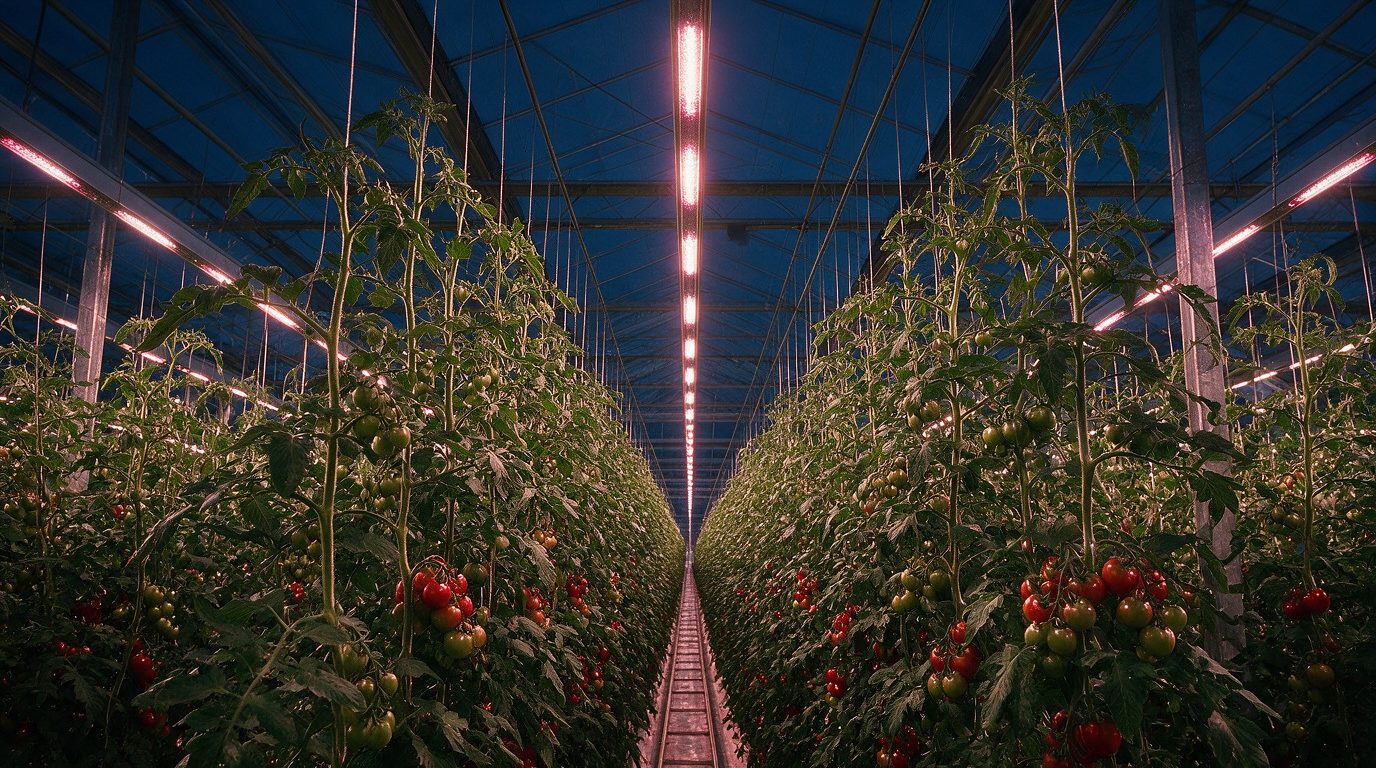
Cultivar-Specific Response of Tomato to Far-Red Light: Screening Results
There is no universal light recipe for tomato protected cultivation: the response to the far-red spectrum is strictly cultivar-dependent. Researchers from Wageningen University (Netherlands) published the results of testing 23 tomato genotypes under supplemental far-red radiation in Frontiers in Plant Science. The study revealed that identical spectral composition can either double productivity or yield no agronomic effect at all.
Experimental Setup and Measured Parameters
The experiments were conducted in controlled-environment climate chambers. Plants were grown on rockwool cubes under a 16-hour photoperiod. Baseline lighting provided a PPFD of 200 μmol/(m²·s) with the spectral distribution: 24% blue (400–500 nm), 40% green (500–600 nm), and 36% red (600–700 nm). In the treatment group, 50 μmol/(m²·s) of far-red radiation in the 700–750 nm range was added to the background, bringing total photon flux density to 250 μmol/(m²·s).
In terms of yield dynamics, the sample split into two groups:
- a significant increase in fresh fruit weight was recorded in only 10 out of 23 genotypes, with yield gains ranging from 31% to 175% compared to the far-red-free control;
- the remaining 13 genotypes showed no statistically significant change in yield under continuous supplementation of 50 μmol/(m²·s) far-red light.
Soluble sugar accumulation on a dry weight basis increased in 16 cultivars (gains from 18% to 88%), while 7 cultivars remained at baseline levels.
To test the phase-sensitivity hypothesis, two insensitive genotypes (cultivars 11 and 22) received supplemental far-red light exclusively during specific developmental stages: from vegetative growth to flowering, from flowering to fruit set, and during ripening. None of the growth stages showed significant yield increases: mean differences ranged from −1.0 to +16.2 g per plant for cultivar 11 and from −1.9 to +19.5 g for cultivar 22, with 95% confidence intervals of −51.3 to +66.6 g and −41.7 to +59.3 g, respectively. Insensitivity is genetically determined rather than caused by a poorly timed application window.
The authors identified an early biomarker: hypocotyl and seedling elongation under the far-red spectrum exhibited a direct linear correlation with ultimate fruit yield increase (correlation coefficient r = 0.89). The more pronounced the seedling elongation response to the far-red shift, the higher the mature plant's response in fruit load.
Implications for Commercial Greenhouse Operations
In regions with low natural solar radiation during autumn and winter, supplemental LED lighting is designed for maximum yield per kilowatt-hour. The far-red spectrum requires additional energy expenditure, lowering the fixture's overall efficacy in μmol/J compared to narrow-band red LEDs.
If a greenhouse facility installs a spectrum with a high proportion of far-red light without prior hybrid evaluation, it risks investing in ineffective photon flux. Cultivars with low fruit sink strength do not convert additional 700–750 nm flux into marketable yield. Conversely, for responsive hybrids, supplemental spectrum accelerates assimilate partitioning to the fruit.
Lighting upgrades require phased verification: cultivar characteristics should be evaluated as early as the seedling stage. Properly configured seedling supplemental lighting systems reveal hybrid internode plasticity two weeks before transplanting to the main greenhouse. This prevents costly errors when scaling up to main production compartments running tomato supplemental lighting projects.
Study Limitations
The findings were obtained using a panel of 23 dwarf determinate cultivars in indoor climate chambers under a stable baseline PPFD of 200 μmol/(m²·s). Commercial greenhouses operate predominantly with indeterminate high-wire hybrids, which feature different canopy light extinction profiles and vertical light gradients. Extrapolating these correlation patterns (including r = 0.89) to high-wire crops requires verification under commercial production conditions.
Key Takeaways
Head growers and greenhouse lighting engineers should not treat far-red light as a universal yield booster. Adding the 700–750 nm band to fixture spectra must be strictly aligned with the facility's cultivar selection. A standard seedling elongation test allows growers to quickly determine whether a specific tomato hybrid justifies the investment in far-red photon flux.
Sources