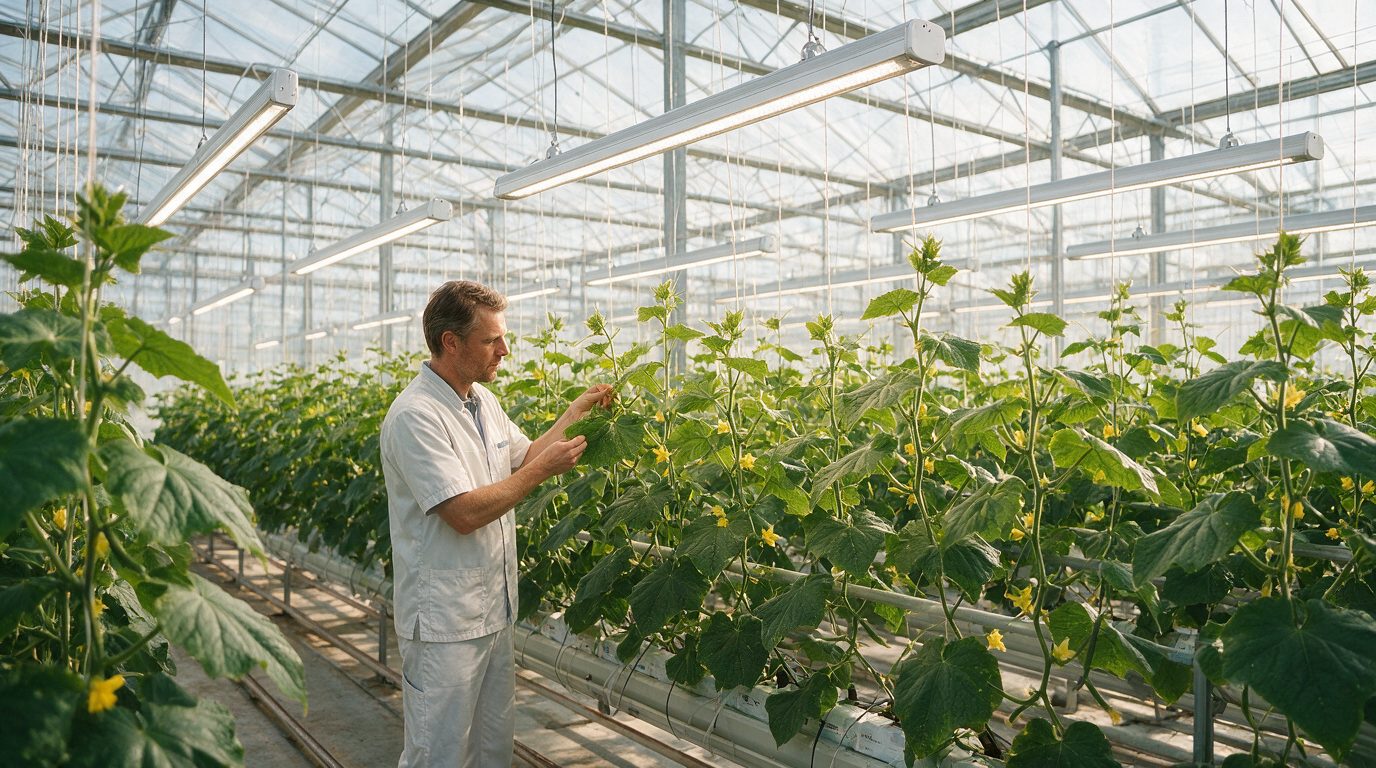
LED Spectrum for Cucumber: Dynamic Regimes and Control Costs
Optimizing spectral composition across plant ontogeny remains a promising way to enhance crop productivity in protected cultivation. The journal Light & Engineering published findings by a research team (Artem O. Lyulyov, Sergey D. Bogatyryov, Olga E. Zheleznikova, Dmitry I. Ivanov) representing National Research Ogarev Mordovia State University and JSC Ardatov Lighting Plant. The work was conducted in collaboration with JSC Teplichnoye specialists and evaluated adjustable spectral regimes in growing Svyatogor F1 cucumber.
Parameters of the Experimental Setup and Prototype Luminaires
Photobiological studies were conducted in an experimental hydroponic setup. Photon flux density was maintained at a stable level: photobiological studies of Svyatogor F1 cucumber were conducted at a photosynthetic photon flux density of (200 ± 10) μmol/(s·m²). This isolated the spectral factor from total irradiation intensity.
For the experiments, prototype grow light luminaires were manufactured at JSC Ardatov Lighting Plant. The design incorporated four independent emitter types: experimental 150 W LED luminaires were used with LEDs at wavelengths of 450 nm (blue), 660 nm (red), 730 nm (far-red), and white LEDs with a color temperature of 5000 K and Ra = 70. White LEDs provided a broadband spectrum, including the green component, while monochromatic channels allowed precise dosing of target wavebands.
Optical radiation was controlled via a digital bus: the bidirectional digital DALI protocol provided smooth regulation of the radiation output of each of the four LED modules in the range from 0 % to 100 % and gave feedback from the power supplies. This architecture enabled shifting spectral formulas without altering the overall PPFD level over the canopy.
Impact of Dynamic Spectrum on Vegetative Growth and Productivity
The authors compared power distribution options across spectral bands at different crop development stages. Experimental data demonstrated a pronounced plant response to changes in the ratio of blue, red, and green components during early growth.
According to the authors' findings, increasing the blue radiation share to (50–55) % with a decrease in the red share by (20–25) % and the green share by (5–10) % during the vegetative growth stage improved seedling biometric parameters and resulted in increased yield of Svyatogor F1 cucumber. The predominance of blue light during the nursery phase produced a compact habitus, prevented internode elongation, and stimulated leaf canopy development with high tissue density, establishing the foundation for fruiting in the generative stage.
What This Means for a Commercial Greenhouse Facility
The results confirm the biological benefit of adjusting light spectrum across vegetative phases; however, implementing dynamic supplemental lighting at facility scale requires engineering and economic evaluation. Principles for calculating irradiation parameters are detailed in the Supplemental Lighting Guide.
Standard cucumber lighting projects rely on fixed-spectrum luminaires tailored for fruiting with red band dominance. Introducing adjustable spectrum increases infrastructure complexity:
- Capital expenditures on luminaires. A multichannel fixture requires separate LED boards and drivers with independent dimming (DALI, 0–10 V), increasing its cost compared to single-channel counterparts.
- Cabling infrastructure and automation. Control lines must be routed to each luminaire, and controllers must be integrated into the facility's climate computer.
- Energy efficiency. Blue LEDs (450 nm) and phosphor-converted white LEDs (5000 K, Ra = 70) have lower photon efficacy (μmol/J) than red LEDs (660 nm). Operating a spectrum with a (50–55) % blue share lowers overall fixture photosynthetic efficacy during the seedling phase.
Industry practice shows that yield gains must be weighed against costs per kWh of installed power, as noted in the article Agroholding Dobryansky Summarized Cucumber Trial Results: Higher Yield with Lower Energy Consumption.
Transferability Constraints of the Study Results
When assessing the applicability of these data to commercial production, several constraints must be considered:
- Scale of the setup. The trial was conducted in an experimental hydroponic installation, where microclimate and light distribution differ from multi-hectare high-ceiling commercial greenhouses.
- Cultivar specificity. The study evaluated the Svyatogor F1 hybrid. The response of other greenhouse cucumber cultivars to a (50–55) % blue share requires dedicated verification.
- Irradiance level. The trial was run at a PPFD of (200 ± 10) μmol/(s·m²), which is typical for nursery compartments but lower than total radiation levels used during full fruiting.
Practical Takeaways for Specialists
Chief Agronomist: Increasing the blue share to 50–55% while reducing red by 20–25% and green by 5–10% during vegetative growth improves seedling quality. In facilities with a dedicated seedling compartment, installing specialized vegetative spectrum luminaires is more rational than complicating fixtures across main production blocks.
Chief Engineer: When evaluating adjustable spectrum systems, weigh the cost of DALI drivers and control networks against projected yield gains. Zoning (a dedicated vegetative spectrum in the nursery block and fixed spectrum in production compartments) is more reliable and cost-effective than deploying dynamic luminaires throughout.
Design Engineer: When specifying DALI spectrum regulation from 0 % to 100 %, account for bus length limitations, line address capacity, and signal cable shielding near high-power electrical equipment.