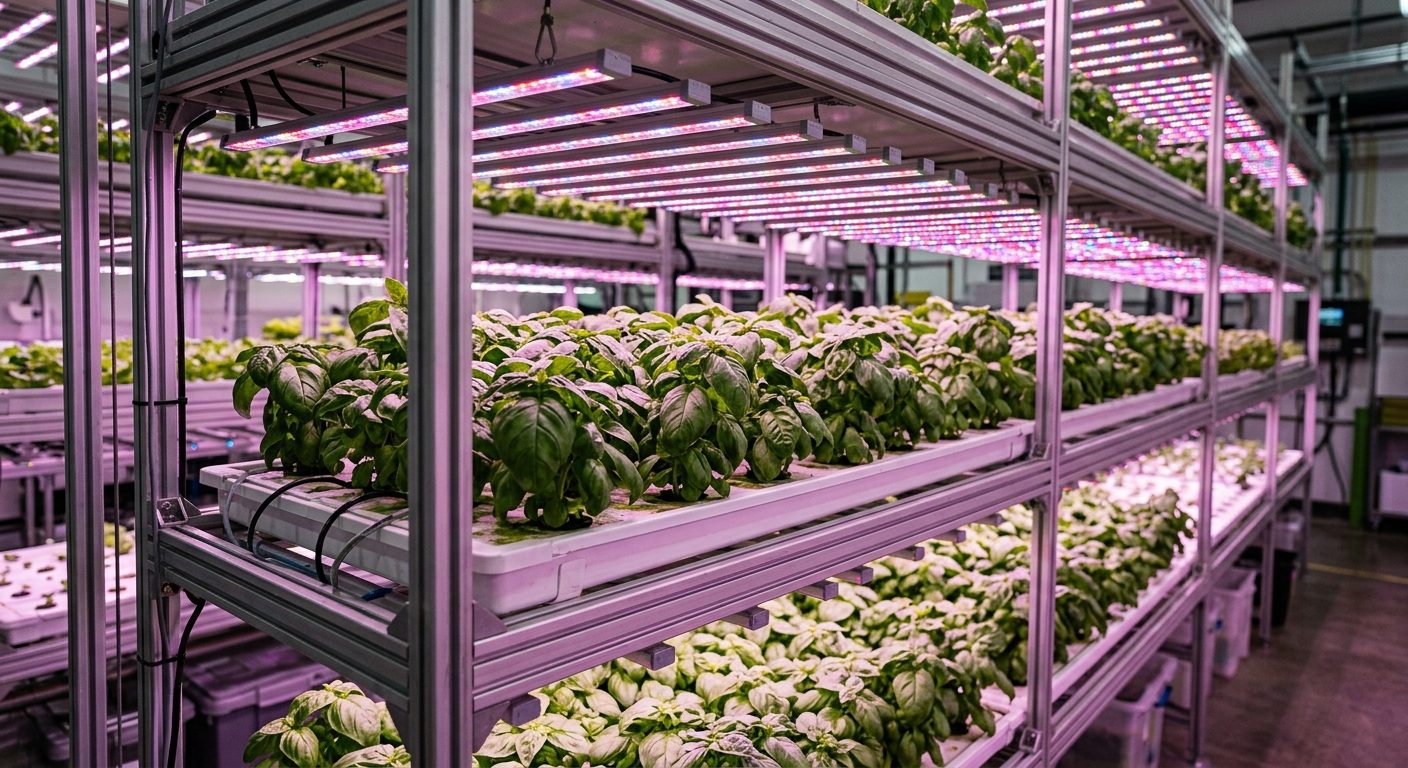
Dynamic Lighting Regimes for Basil: Boosting Dry Mass by 9%
The Core Experiment: Dynamic vs. Static Lighting at Equal DLI
Increasing energy efficiency in leafy greens lighting is typically reduced to finding a balance between PPFD level and photoperiod duration. Most commercial protocols rely on a static profile: uniform photon flux density and a fixed day length throughout the entire crop cycle. A research team from the University of California, Davis and University College London tested the hypothesis that dynamically adapting the lighting regime to plant ontogeny can enhance light use efficiency (LUE) and biomass accumulation without increasing the cumulative DLI.
In a growth chamber, the researchers grew Genovese basil (Ocimum basilicum L.) over a 24-day cycle. The study aimed to compare crop responses under constant and stepped lighting regimes while maintaining an identical average DLI across the entire 24-day rotation.
Experimental Parameters and Treatments
The trial evaluated four lighting strategies with different combinations of PAR intensity and photoperiod:
- CIP (control): constant PAR intensity of 300 μmol/(m²·s) and a constant 16-hour photoperiod;
- CIDP: constant intensity of 300 μmol/(m²·s) with a dynamic photoperiod (stepped increase: 14, 16, and 18 hours);
- DICP: dynamic intensity with steps of 200, 300, and 400 μmol/(m²·s) under a constant 16-hour photoperiod;
- DIP: dynamic intensity (200, 300, and 400 μmol/(m²·s)) combined with a dynamic photoperiod (14, 16, and 18 hours).
All four treatments were balanced for total radiant energy input over the growing period. This enabled a direct comparison of canopy productivity under identical baseline electricity inputs for photons.
Results: Dry Matter Gains and Crop Physiology
The combined dynamic increase in PPFD and photoperiod (DIP treatment) demonstrated a statistically significant advantage over standard static lighting (CIP):
- dry biomass accumulation increased by 9%;
- light use efficiency (LUE) improved by 9%;
- optically measured chlorophyll content was 19% higher;
- stomatal conductance under the constant CIP regime was 25% higher than in the dynamic DIP treatment, indicating more economical transpirational water use under a stepped photoperiod.
Extending the photoperiod alone without adjusting intensity (CIDP treatment) resulted in the poorest performance among all setups, recording the lowest leaf area, fresh and dry biomass, carotenoid and chlorophyll content, and non-photochemical quenching (NPQ). Simply manipulating lighting hours for seedlings without a synchronized change in PPFD disrupts physiological balance and fails to deliver benefits.
Implications for Protected Cultivation
For greenhouse and vertical farm agronomy and engineering teams, these findings provide physiological justification for zoning and stepped dimming. During the initial days of growth, basil seedlings cannot efficiently absorb high PPFD levels: canopy leaf area is small, and photosynthetic light saturation thresholds are not yet established. Delivering a standard 300 μmol/(m²·s) during this stage leads to unproductive light and energy losses.
Reducing intensity to 200 μmol/(m²·s) at the start alongside a shorter 14-hour day allows the crop to acclimate without photoinhibition. As the leaf area index expands, increasing the flux to 400 μmol/(m²·s) and extending the photoperiod to 18 hours loads the photosynthetic apparatus at its peak capacity. Under northern latitude conditions with high winter electricity costs, this strategy saves energy during early phases and delivers higher marketable yields at final harvest.
Implementing this approach in practice requires controllable LED fixtures with group dimming capabilities across sections or nursery zones, as demonstrated in projects featuring flexible lighting scenarios. In facilities growing leafy greens on hydroponic gutter systems, stepped profiles are organized physically: by dividing racks or spans into light zones aligned with seedling age.
Study Limitations
When applying these findings to commercial operations, several trial conditions must be considered:
- the trial was conducted in a growth chamber without natural sunlight, so applying these profiles to greenhouses with supplemental lighting requires adjustments for solar radiation;
- the experiment evaluated a single cultivar, Genovese basil, over 24 days; responses of other cultivars and crops with similar canopy architecture require separate validation;
- the study authors emphasize the need for further testing to assess postharvest shelf life, essential oil yield, and secondary metabolite dynamics under dynamic lighting profiles.
Takeaways for Agronomists and Engineers
Head agronomists gain a practical method to increase basil dry mass by 9% with zero added energy consumption through synchronized scaling of PPFD (from 200 to 400 μmol/(m²·s)) and photoperiod (from 14 to 18 hours). For lead engineers and designers, the data reinforces the rationale for specifying multi-zone supplemental lighting control systems: shifting from fixed to adjustable regimes optimizes facility energy balance without sacrificing productivity, as shown by commercial results in other crops.
Sources