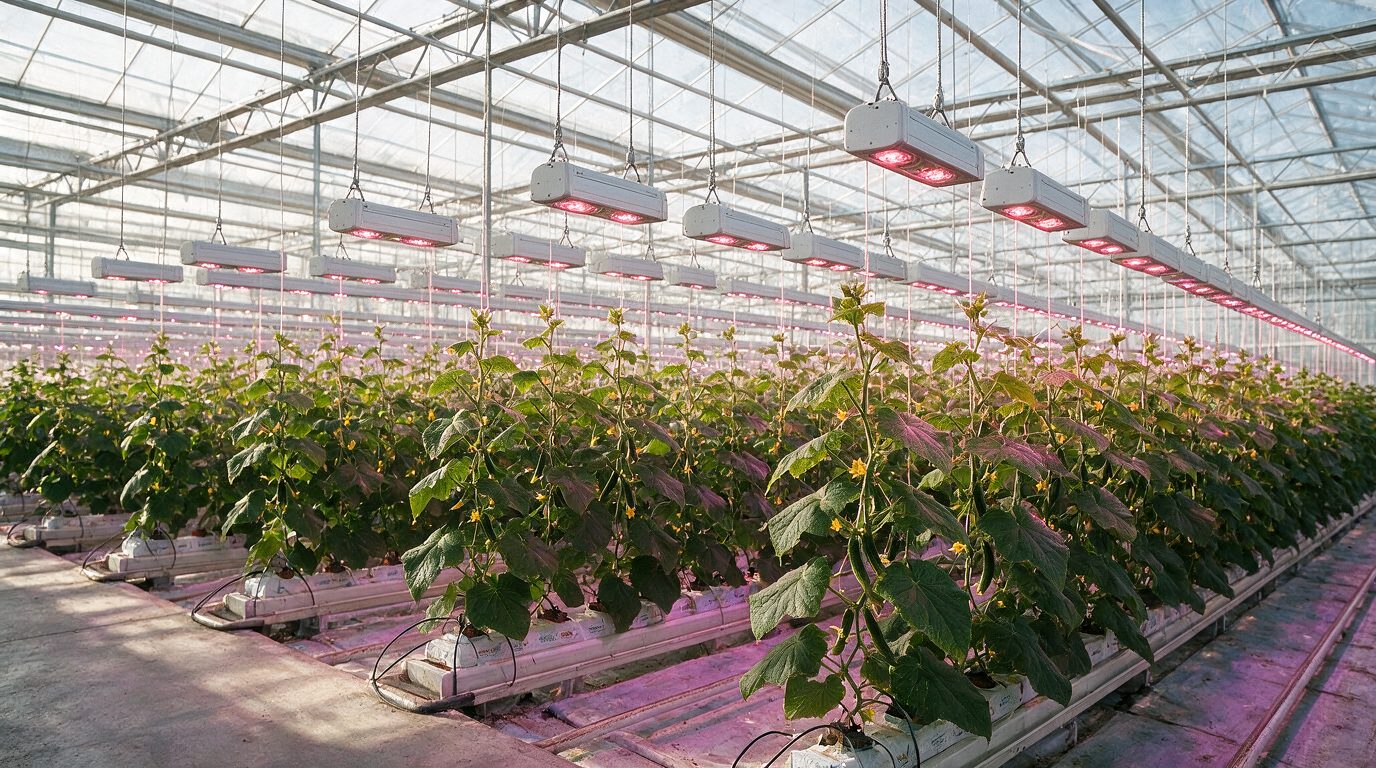
Cucumber Lighting Spectrum: Red and Far-Red Balance Over 12 Crop Cycles
Optimizing the spectral composition of irradiation increases plant productivity in protected cultivation. For lighting culture, regulating the plant phytochrome system via the proportions of red and far-red spectra is essential. A research team (A. E. Kurshev, S. D. Bogatyrev, O. E. Zheleznikova, A. O. Lyulyov) presented the results of an experiment studying cucumber responses to varying fractions of these wavelength bands over an extended production cycle.
Methodology and Parameters of the Multi-Cycle Experiment
The study was conducted on an experimental hydroponic facility under continuous monitoring of optical parameters. The authors developed their methodological approach to photobiological trials jointly with specialists from the Teplichnoye agrotechnical complex. The research subject was the cucumber hybrid Svyatogor F1, widespread in commercial protected cultivation. The key requirement was reproducibility of results: lighting culture studies on the cucumber hybrid Svyatogor F1 were conducted over 12 full crop cycles (vegetations).
The trials utilized LED grow lights with independent spectral channel control. Hydroponic experiments were conducted at a photosynthetic photon flux density (PPFD) level of (200 ± 10) μmol/(s·m²). The experiment investigated the effect of the ratio of red radiation in the 600–700 nm range and far-red radiation in the 700–780 nm range on growth processes, morphogenesis, and final plant productivity.
Optimal Ratio of Far-Red to Red Radiation
Varying the spectral composition demonstrated a clear dependence of crop development on long-wave radiation. The highest efficiency of biometric and yield indicators in cucumber was achieved at a far-red to red radiation ratio from 30/70 % to 60/40 %. Adding far-red light within these limits stimulated photobiological processes and leaf canopy development.
At the same time, the authors identified an upper technological ceiling. Increasing the proportion of far-red radiation in the spectrum to 70 % or more was deemed impractical. An excessive spectral shift toward the far-red region leads to undesirable morphological deformations and reduced productivity in lighting culture, negating the positive effect of phytochrome stimulation.
Significance of Results for Commercial Greenhouse Facilities
For chief agronomists, these findings confirm the necessity of precise spectrum tuning when selecting LED equipment. In production schemes featuring greenhouse cucumber supplemental lighting, integrating the far-red band (700–780 nm) at 30 to 60 % relative to red (600–700 nm) optimizes plant habitus and improves incident PAR utilization. The experiment's duration across 12 full vegetation cycles eliminates seasonal fluctuation factors and validates the stability of the hybrid's physiological response.
For engineers developing cucumber supplemental lighting projects, these results provide a guideline for configuring LED module spectral composition. If the design brief requires an adjustable spectrum, the designer must consider the 70 % limitation: provisioning surplus power for the far-red channel leads to unwarranted capital expenditure without agronomic return.
Transfer Limitations and Implementation Specifics
When applying these findings to commercial protected cultivation facilities, several boundary conditions must be considered:
- Cultivar specificity: The trial was conducted on the Svyatogor F1 hybrid. Other cucumber genotypes may exhibit different sensitivity thresholds to far-red light.
- Irradiance level: Testing was performed at a fixed level of (200 ± 10) μmol/(s·m²). At different PPFD levels, growth response dynamics require dedicated verification.
- Spectral boundaries: The red band was evaluated within 600–700 nm, and far-red within 700–780 nm. Ratios are calculated strictly for these spectral corridors.
Practical Recommendations
When selecting grow lights with fixed or dynamic spectra, chief agronomists are advised to request a spectroradiometric datasheet detailing the 600–700 nm and 700–780 nm bands from the manufacturer. During supplemental lighting modernization, it is advisable to maintain a far-red to red ratio between 30/70 % and 60/40 %, avoiding levels above the 70 % share. In lighting layout calculations, design engineers should align the power consumption of long-wave LEDs with the agronomic demand of the crop, avoiding an overspecified far-red spectrum share.