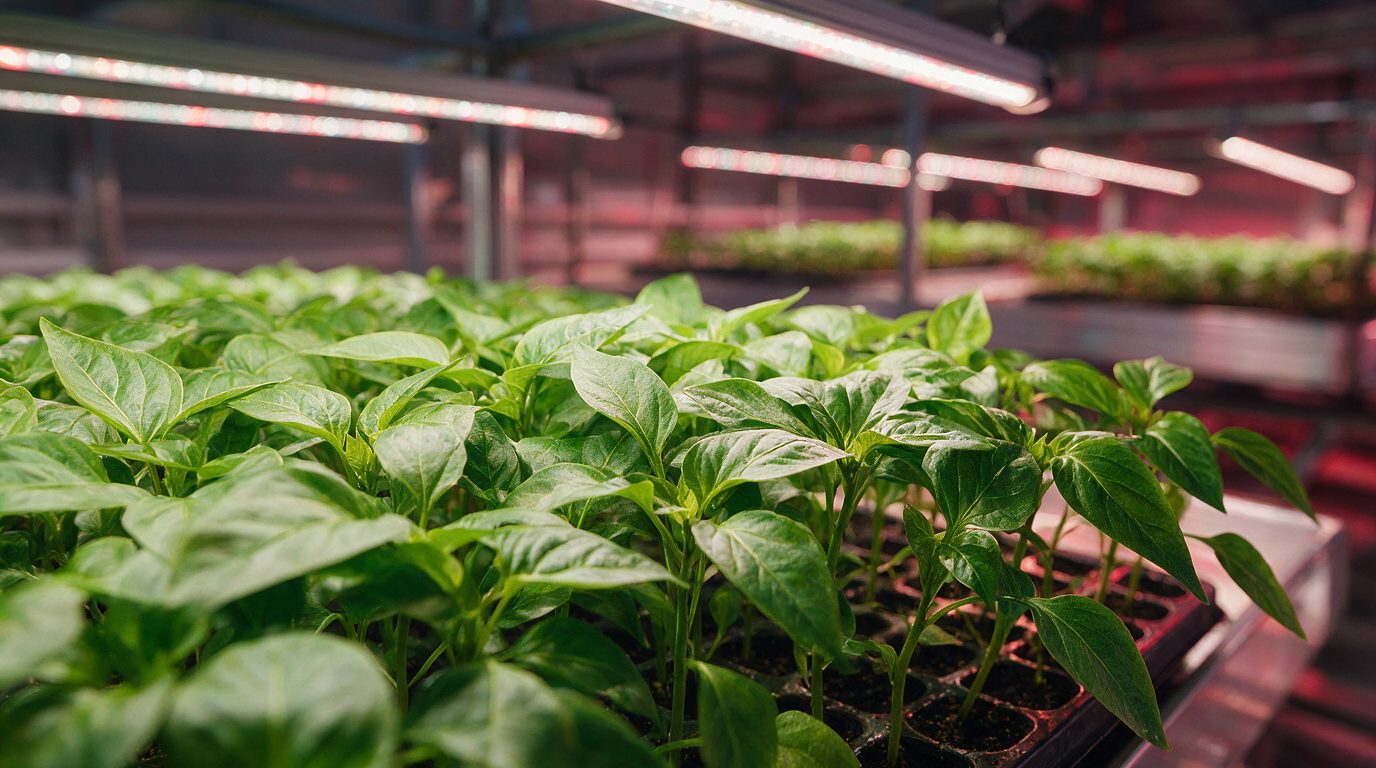



Sweet Pepper Seedling Supplemental Light Spectra: Narrow vs. Mixed Bands
A study published in the scientific journal ACS Omega examined the effects of different LED spectral bands on the development of sweet pepper (Capsicum annuum L.) seedlings. The experiment evaluated physiological, biochemical, and biometric plant parameters, as well as mineral nutrient uptake dynamics in a controlled light environment.
Experimental Parameters and Physiological Responses
The trial followed a completely randomized design in three replicates with 10 plants per treatment. The researchers investigated monochromatic spectra at 450 nm (blue), 660 nm (red), and 530 nm (green), along with white light (W), full-spectrum white light (WF), and a 50/50 red (660 nm) and blue (450 nm) combination. Statistical significance was determined using analysis of variance (ANOVA) and Tukey's test at a 95% confidence interval. Principal component analysis (PCA) was used to evaluate biometric traits, photosynthetic activity, chlorophyll fluorescence parameters, accumulation of phenolics, flavonoids, and anthocyanins, and mineral nutrient uptake.
Instrumental measurements showed clear differentiation in crop response across spectral treatments:
- Red light at 660 nm promoted shoot elongation and aerial fresh and dry biomass accumulation, inducing significant internode stretching;
- White light and the 50% red (660 nm) / 50% blue (450 nm) bicolor spectrum stimulated leaf lamina expansion and assimilation area development;
- The 50/50 bicolor treatment delivered the highest accumulation and uptake of micronutrients, specifically zinc (Zn), copper (Cu), and manganese (Mn);
- The green spectrum at 530 nm increased the accumulation of secondary metabolites, including the total phenolic pool.
Agronomic Relevance for Greenhouse Seedling Facilities
For commercial greenhouse complexes in high-latitude regions, producing quality pepper seedlings during winter is constrained by severe natural PAR deficits and low blue light fractions. When designing seedling departments, the primary agronomic goal is to prevent hypocotyl stretching while maintaining leaf initiation rates and root system development.
The study highlights the operational risks of an unbalanced spectrum. Dominant 660 nm radiation triggers excessive stem elongation. In winter seedling compartments, this leads to weak, lodging seedlings with stretched internodes. Conversely, adding blue light at 450 nm up to 50% alongside red light suppresses etiolation and promotes balanced leaf morphogenesis.
Mineral nutrition data are equally notable. Enhanced uptake of Zn, Cu, and Mn under 50% red (660 nm) and 50% blue (450 nm) indicates the activation of enzyme systems and respiratory metabolism. Zinc and manganese are directly involved in photosystem II oxygen-evolving complex function and auxin biosynthesis. Properly designed seedling supplemental lighting projects improve seedling resilience during transplanting into production greenhouses.
Experimental Model Limitations
When analyzing these findings, several research protocol parameters should be noted:
- The trial was conducted on seedlings inside a closed growth chamber without natural daylight, meaning plant responses in hybrid lighting regimes with natural sunlight may show quantitative variations;
- The published data present qualitative and relative trait distributions along PCA axes without specifying energy consumption per unit of biomass gain or daily light integral (DLI) levels;
- The evaluation focused strictly on the seedling phase and did not track flowering or fruiting stages, preventing direct extrapolation across the full crop cycle.
Practical Takeaways for Greenhouse Agronomists
For greenhouse seedling compartments, the study confirms that using narrow-band monochromatic red light without a substantial shortwave fraction is counterproductive. When growing sweet pepper seedlings under short winter days, lighting strategies should rely on full-spectrum fixtures or bicolor configurations where blue light peaking at 450 nm reaches up to 50%. This controls plant height, promotes leaf area expansion, and optimizes micronutrient uptake without the risk of stem elongation.
Sources