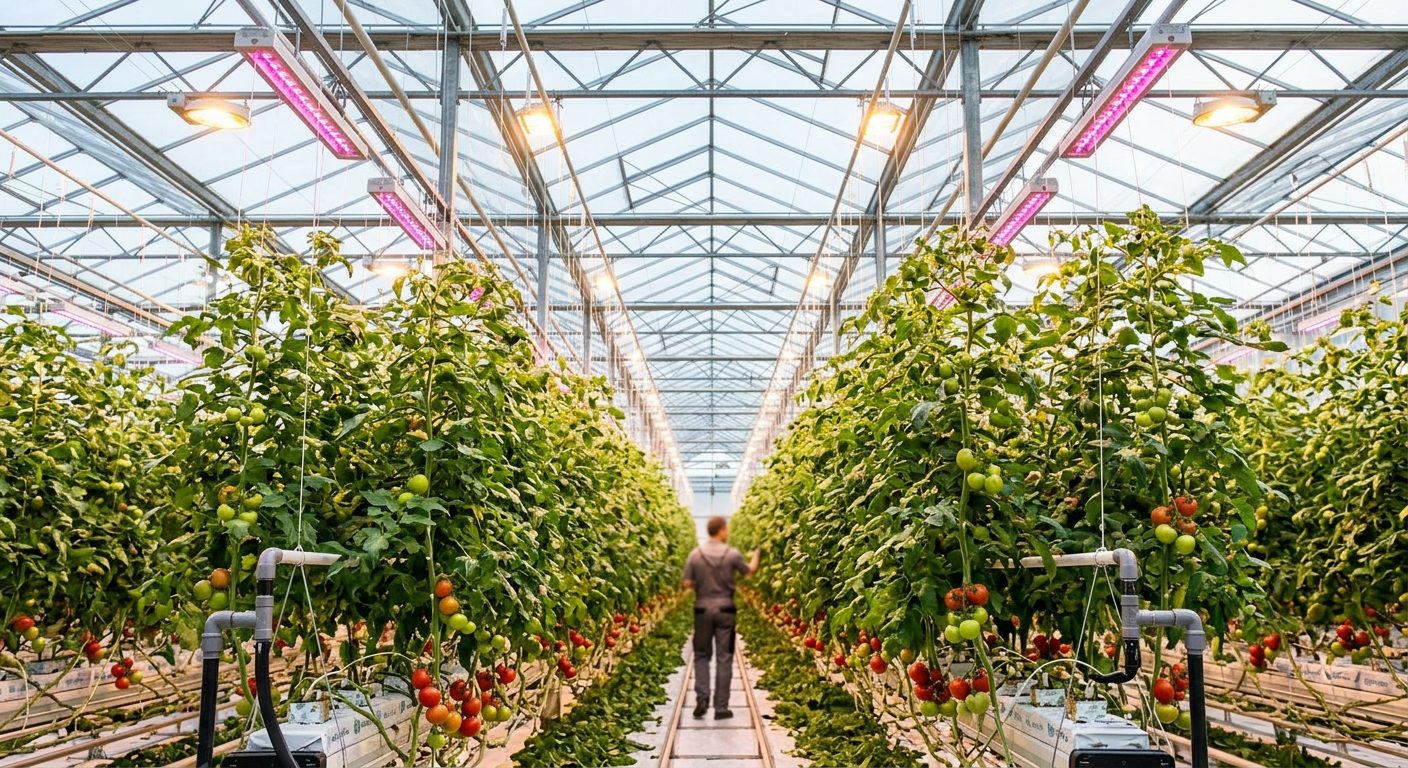
Hybrid Supplemental Lighting vs Full LED in Northern Greenhouses
Direct Trial Results of HPS, LED, and Hybrid Systems
Researcher Christina Stadler from the Agricultural University of Iceland conducted a direct comparison of three supplemental lighting strategies in protected cultivation: high-pressure sodium (HPS) lamps, full LED installations, and a hybrid scheme (HPS + LED). The study focused on finding the balance between energy inputs, biomass accumulation, and commercial product quality during winter under minimal natural solar radiation.
In geothermal-heated greenhouse conditions, the author evaluated the effect of different light sources on fresh weight accumulation, leaf pigmentation in red winter lettuce, and the specific energy efficiency of supplemental lighting.
Actual Parameters and Measured Metrics
During two greenhouse trials, the following microclimate and light environment parameters were recorded:
- LED luminaires: provided a photosynthetic photon flux density of 167 μmol/(m²·s) at a daytime air temperature of 20 °C.
- High-pressure sodium (HPS) lamps: provided a photosynthetic photon flux density of 132 μmol/(m²·s) at a daytime air temperature of 19 °C.
- Hybrid circuit: combined HPS and LED luminaires to deliver a mixed spectrum and intermediate flux density.
A complete transition of the compartment to LED lighting reduced supplemental lighting electricity consumption by 37% compared to the HPS system. Furthermore, the LED option demonstrated the highest energy efficiency: plant fresh weight yield per kilowatt-hour consumed was highest under LEDs.
The hybrid system reduced electricity costs by only 9% relative to pure HPS lamps. At the same time, this scheme did not increase specific energy efficiency: the power reduction was insufficient to offset the difference in yield output per unit of energy.
Regarding quality metrics, pure LEDs with higher PPFD stimulated anthocyanin accumulation and intensified red leaf coloration, although fresh weight was lower than under HPS radiation with its predominant thermal spectrum. The hybrid configuration improved pigmentation compared to HPS lamps, but the target color saturation threshold was not reached.
Analysis for Commercial Greenhouses
For head growers and greenhouse engineers, these findings challenge the assumption of guaranteed benefits from a hybrid transition. Retaining part of the HPS fixtures while adding LEDs is often seen as a way to reduce capital expenditures and maintain radiant heat, but calculations reveal the bottlenecks of this approach.
A 9% energy reduction from a hybrid retrofit does not offset the added complexity of the electrical network, the procurement of mismatched equipment, and its maintenance. Additionally, growers must calculate the total daily light integral taking into account two distinct spectra, as detailed in the article on how much light plants need in a greenhouse (PPFD and DLI).
Under short northern winter photoperiods, direct return per kilowatt-hour plays a decisive role. A full switch to LEDs, cutting energy use by 37%, enables operations either to relieve load on the electrical infrastructure or to increase PPFD proportionally without expanding transformer substation capacity.
Study Limitations
When transferring these findings to commercial production, experimental boundary conditions must be taken into account:
- The trials were conducted on red lettuce, where marketable quality depends on balancing growth rate and pigment synthesis. For cucumber or tomato crops, the yield-to-spectrum dynamics differ.
- The greenhouses were heated via geothermal loops, eliminating the heat deficit issue that occurs when phasing out HPS lamps in cold winter climates.
- Comparisons were carried out under fixed temperature regimes (19 °C and 20 °C) without dynamic screen control tailored to luminaire heat dissipation.
Engineering Conclusions
When upgrading lighting systems or designing new facilities, hybrid supplemental lighting schemes require rigorous techno-economic justification. If the retrofit objective is to cut energy costs and increase output per square meter, a hybrid setup yielding only a 9% saving proves to be a half-measure.
Engineering teams will find it more rational to pursue a complete conversion to LEDs with up to 37% energy savings—compensating for heat through heating loops and thermal screens—rather than maintaining a mixed infrastructure with low specific return on investment.
Sources