Increasing Lettuce Supplemental Lighting: Diminishing Returns and Dynamic Strategies
When designing and retrofitting gutter lettuce systems in protected cultivation, calculating the optimal target irradiance remains a critical engineering task. Determining whether increasing photosynthetic photon flux density yields a proportional gain in marketable yield or results in diminishing returns per consumed kilowatt-hour requires physiological evidence. Specialized research on lettuce physiology in controlled environments provides quantitative benchmarks for increasing light intensity and deploying dynamic spectrum and irradiance management.
Lettuce Physiological Response to Elevated Photon Flux Density
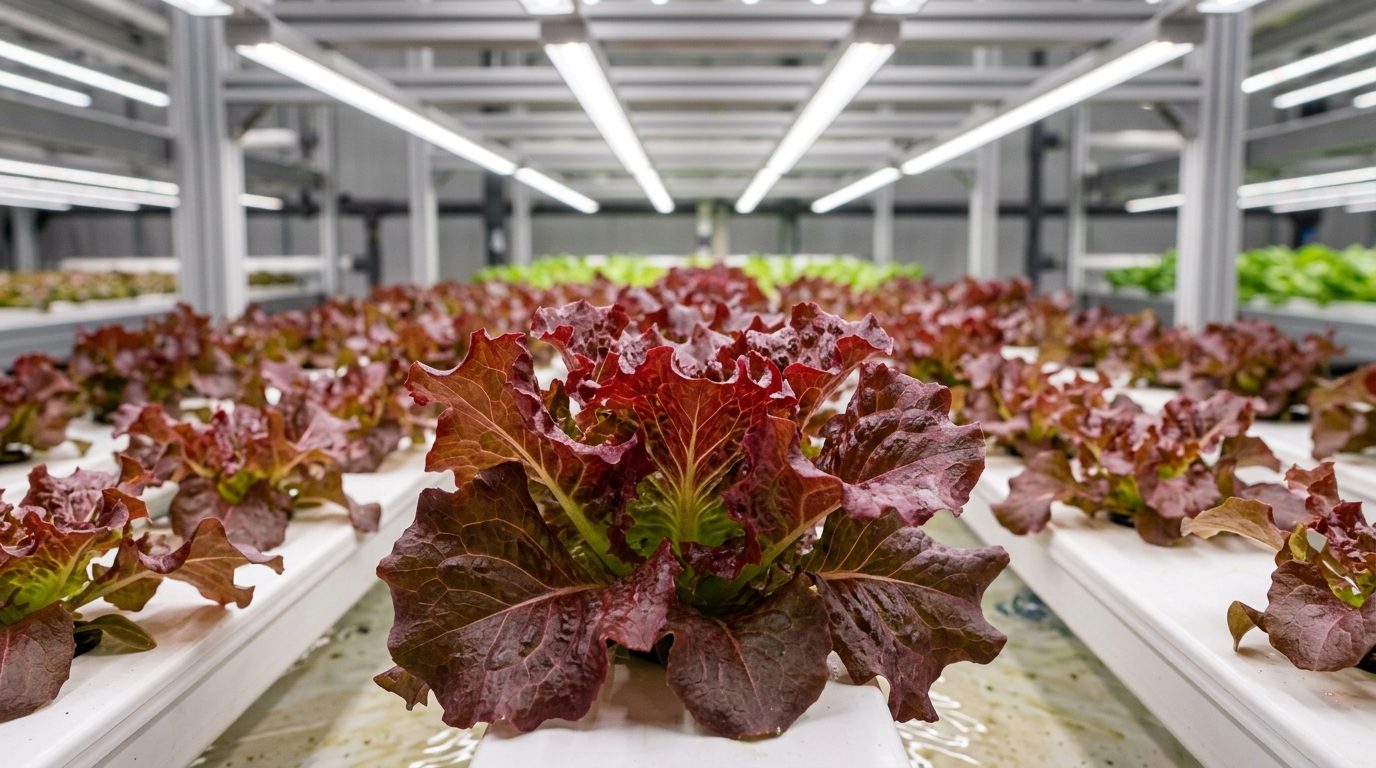
In a study published in Frontiers in Plant Science, a research team evaluated the response of red-leaf lettuce 'Rouxai' to varying photon flux levels and dynamic lighting regimes under a continuous 24-hour photoperiod in hydroponic cultivation. The authors recorded a pronounced morphological and biomass response to elevated irradiance.
At the seedling stage (11 days after sowing), increasing PPFD from 150 to 350 µmol m –2 s –1 increased shoot fresh mass by 69% (from 0.28 to 0.47 g) and shoot dry mass by 84% (from 0.02 to 0.04 g). The seedlings developed a more compact canopy architecture with increased leaf lamina width.
For mature plants under constant irradiance, elevated photon flux also stimulated biomass accumulation. As the authors established, increasing the fixed PPFD from 150 to 350 µmol m –2 s –1 increased shoot fresh and dry mass by 66% and 70%, respectively, leaf number by 23%, leaf width by 11%, and chlorophyll concentration index by 37%, while decreasing light use efficiency by 27%–29%. This decline in light use efficiency (LUE) indicates that a linear increase in continuous photon flux is subject to diminishing marginal photosynthetic returns.
Advantages of Dynamic Step-Up Lighting by Growth Stage
Because the canopy footprint of young seedlings is minimal and intercepts only a small fraction of delivered photons, operating grow lights at full output during early development causes direct energy losses. The researchers tested dynamic step-up lighting schemes divided into three distinct phases: lag phase (days 0–11), exponential growth phase (days 11–25), and finishing phase before harvest (days 25–28).
The results showed that the 250→250→350 alternation had 23%–31% higher light use efficiency than the fixed 350 treatment while producing comparable final biomass. Maintaining moderate irradiance during the early stages followed by ramped-up output during the finishing stage produces identical marketable head weight with substantially lower total electricity consumption.
Impact of Irradiance on Secondary Metabolite Accumulation
Beyond vegetative fresh weight, lighting intensity determines consumer quality metrics in leafy greens, including leaf thickness and antioxidant profile. In a study published in Frontiers in Plant Science on 'Rex' butterhead lettuce, researchers found that higher TPFD enhanced the concentration of carotenoids by 8%, flavonoids by 19%, phenolics by 42%, and antioxidant capacity by 31% when total photon flux density (TPFD, 400–800 nm) was increased from 150 to 300 μmol/(m²·s).
Elevated irradiance activates photoprotective metabolic pathways in plants, resulting in denser leaf tissue and richer pigmentation, which improves visual marketability and post-harvest shelf life during transport.
Implications for Commercial Greenhouse Operations
For head growers and greenhouse technical directors, these empirical findings provide an actionable framework for calculating supplemental lighting installations. Principles governing the relationship between PPFD, daily light integral (DLI), and photoperiod demonstrate that increasing luminaire rated output without zoned control reduces the economic return per mole of delivered photons.
When planning a lettuce gutter system retrofit or adjusting crop lighting recipes, commercial operations should incorporate the following practices:
- Zoning across production lines. Nursery benches and early gutter line positions do not require high PPFD levels. Ramping up irradiance to maximum levels should be confined to the final stages of the production cycle.
- Reducing specific power consumption. Implementing a dynamic, stepped lighting schedule via dimming controls reduces operating expenses per kilowatt-hour without compromising biomass accumulation rates.
- Microclimate coupling. Higher photon flux densities demand coordinated management of greenhouse temperature, vapor pressure deficit (VPD), and fertigation EC to fully exploit photosynthetic capacity without inducing inner tipburn.
Operational experience with LED installations in commercial production is detailed in our case study on lettuce cultivation trials in commercial greenhouse facilities, comparing growth dynamics and energy consumption.
Transfer Limitations and Engineering Conclusions
The reviewed experimental data were obtained in closed indoor chambers under artificial lighting with a continuous 24-hour photoperiod and constant climate parameters. In commercial glasshouses, crops are subject to natural solar radiation, diurnal temperature and humidity fluctuations, and standard 16–18 hour photoperiods. Direct application of absolute figures therefore requires adjustments for target Daily Light Integral (DLI) and ambient solar sum.
The primary actionable takeaway for designing new automated gutter lines or retrofitting luminaires is to incorporate zoned output dimming along the crop movement trajectory. This prevents energy waste during the seedling stage while securing required marketable weight and foliage density at harvest.
Sources