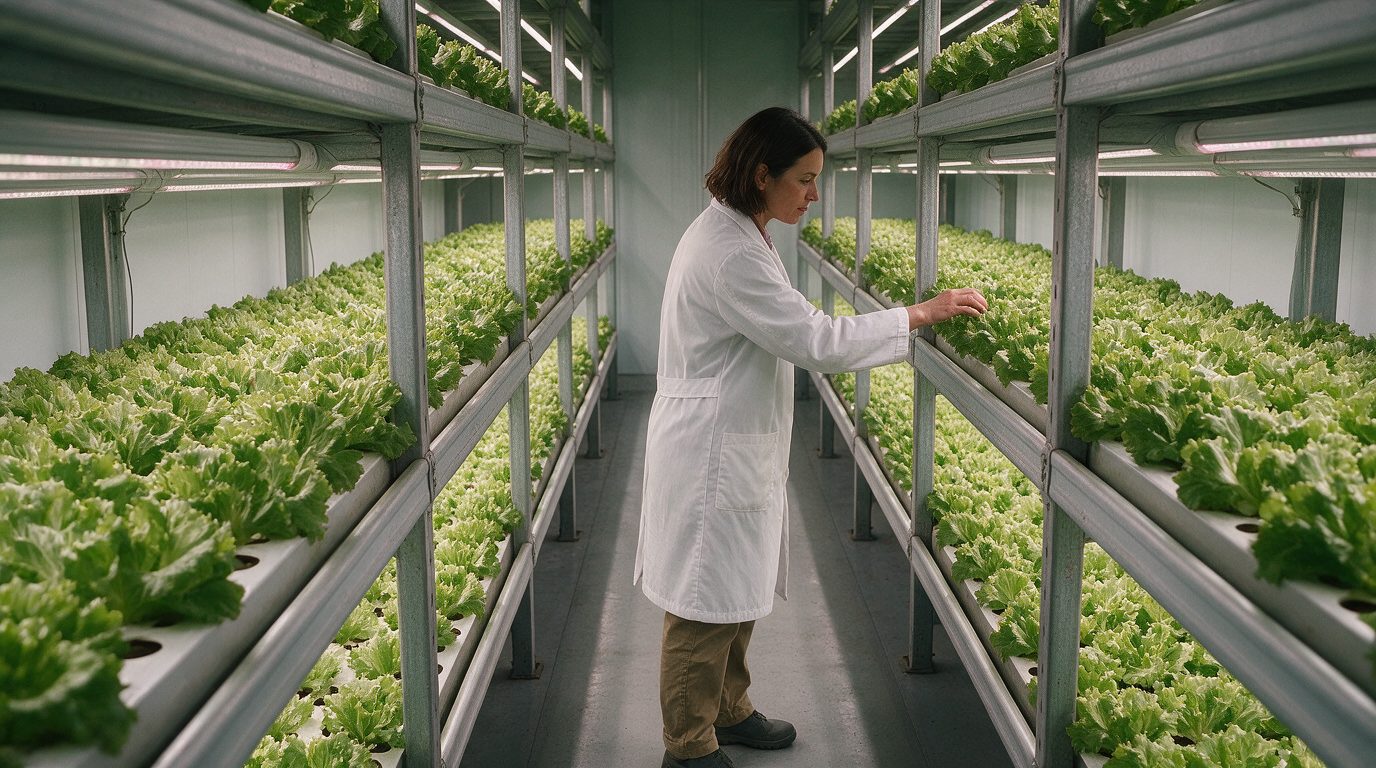
Continuous Lighting at Constant DLI: Impact on Lettuce Yield
Transitioning to continuous lighting while maintaining a constant daily light integral (DLI) allows reducing photosynthetic photon flux density (PPFD) without sacrificing total radiation received by the crop. A study published in Frontiers in Plant Science evaluated the impact of continuous lighting on loose-leaf lettuce (Lactuca sativa) cultivars Danstar and Jagger. The trial was conducted under fully controlled vertical farm conditions at a fixed DLI of 16.9 mol/(m²·day), comparing a baseline 18-hour photoperiod with continuous 24-hour lighting.
Morphological Response and Biomass Accumulation
The experiment lasted 19 days after transplanting (19 DAT). Plants under continuous light accumulated biomass faster than under the control 18-hour photoperiod. Averaged across both cultivars, 24-hour lighting increased shoot fresh weight by 15% and dry weight by 18%. Crop response showed cultivar specificity:
- The Jagger cultivar (characterized by flat horizontal leaves and rapid growth rate) gained 23% in fresh and dry weight, while leaf area index (LAI) also increased by 23%. Total light interception over 19 days increased by 10%.
- The Danstar cultivar (with vertically oriented curly leaves) showed a 6% increase in fresh weight and a 14% increase in dry weight, with a non-significant change in LAI (6% increase).
Light use efficiency of intercepted light (LUE) under the 24/0 regime increased by 7% based on fresh weight and by 11% based on dry weight. As explained in the guide to PPFD, DLI, and photoperiod, lowering instantaneous radiation intensity shifts the photosynthetic apparatus into a higher quantum yield range, preventing photosystem II saturation.
Carbohydrate Metabolism and Product Quality
The risk of continuous lighting is often associated with circadian rhythm disruption, excessive sugar accumulation in tissues, and the development of tip-burn or chlorosis. In this experiment, visual inspection on day 19 revealed no symptoms of tip-burn, chlorosis, or premature bolting in either cultivar.
Biochemical analysis showed an adjustment in carbohydrate metabolism. Leaf sucrose concentration under continuous lighting decreased by an average of 15% relative to the 18-hour regime. Concurrently, starch content increased by 12% in Danstar and by 49% in Jagger. Glucose and fructose contents remained virtually unchanged: glucose concentration was 21.8 mg/g dry weight in both regimes, while fructose was 28.6 vs. 33.2 mg/g. Plants adapted assimilate transport to the absence of a dark period, partitioning excess carbon into starch reserves without toxic effects on tissue.
Energy Balance and Infrastructure Load
The authors modeled the energy consumption of the lighting system and climate control (HVAC) at an identical DLI of 16.9 mol/(m²·day):
- At equal luminaire efficacy of 3.6 μmol/J (baseline scenario A at 23 °C), lighting electricity consumption was 31.0 kWh/m² in both variants. Due to evenly distributed heat dissipation, HVAC costs decreased by 4% (from 9.6 to 9.2 kWh/m²), and total energy consumption decreased by 1% (from 40.6 to 40.2 kWh/m²). Energy use efficiency (EUE) increased by 16% on a fresh weight basis and by 18% on a dry weight basis due to higher yield.
- Accounting for improved LED efficacy at reduced drive current (3.6 μmol/J under 24/0 vs. 3.4 μmol/J under 18 hours, scenario B), lighting costs dropped by 6% (31.0 vs. 32.8 kWh/m²), HVAC load fell by 10% (from 10.2 to 9.2 kWh/m²), and total energy consumption decreased by 6% (from 43.0 to 40.2 kWh/m²). EUE gains reached 23% for fresh weight and 26% for dry weight.
- Under a diurnal temperature regime (24 °C day / 20 °C night, scenario C), total consumption decreased by 7% (from 43.4 to 40.3 kWh/m²), and HVAC costs dropped by 11% (from 10.5 to 9.3 kWh/m²), delivering an EUE increase of 24% for fresh weight and 27% for dry biomass.
These patterns align with the principles discussed in the article on optimizing photoperiod and PPFD at fixed DLI.
Study Limitations
The experiment was conducted in a closed growth chamber without natural solar radiation. The results cannot be directly transferred to commercial greenhouses with sunlight during the spring-summer period, when DLI fluctuates dynamically. Furthermore, the trial evaluated two lettuce cultivars over a single 19-day cycle, while planting density and spectrum remained constant.
Key Takeaways for Agronomists and Engineers
For head agronomists, switching to a 24/0 regime in closed seedling or lettuce production compartments shortens crop cycle duration: a 2–3 day reduction in vegetative time is achieved through 15–23% biomass gains without compromising commercial quality or causing physiological disorders. Cultivar trials are recommended before implementation, as crop response depends heavily on canopy architecture.
For facility engineers and system designers, continuous operation directly reduces peak electrical capacity of the LED installation by 25% by extending DLI delivery from 18 to 24 hours. This decreases cable cross-sections, main breaker ratings, and transformer sizing. Evening out heat output reduces peak cooling and ventilation loads by 10–11%, eliminating temperature spikes associated with light switching cycles.
Sources