LED Retrofits in Winter Tomato Crops: Why Fruit Quality Drops
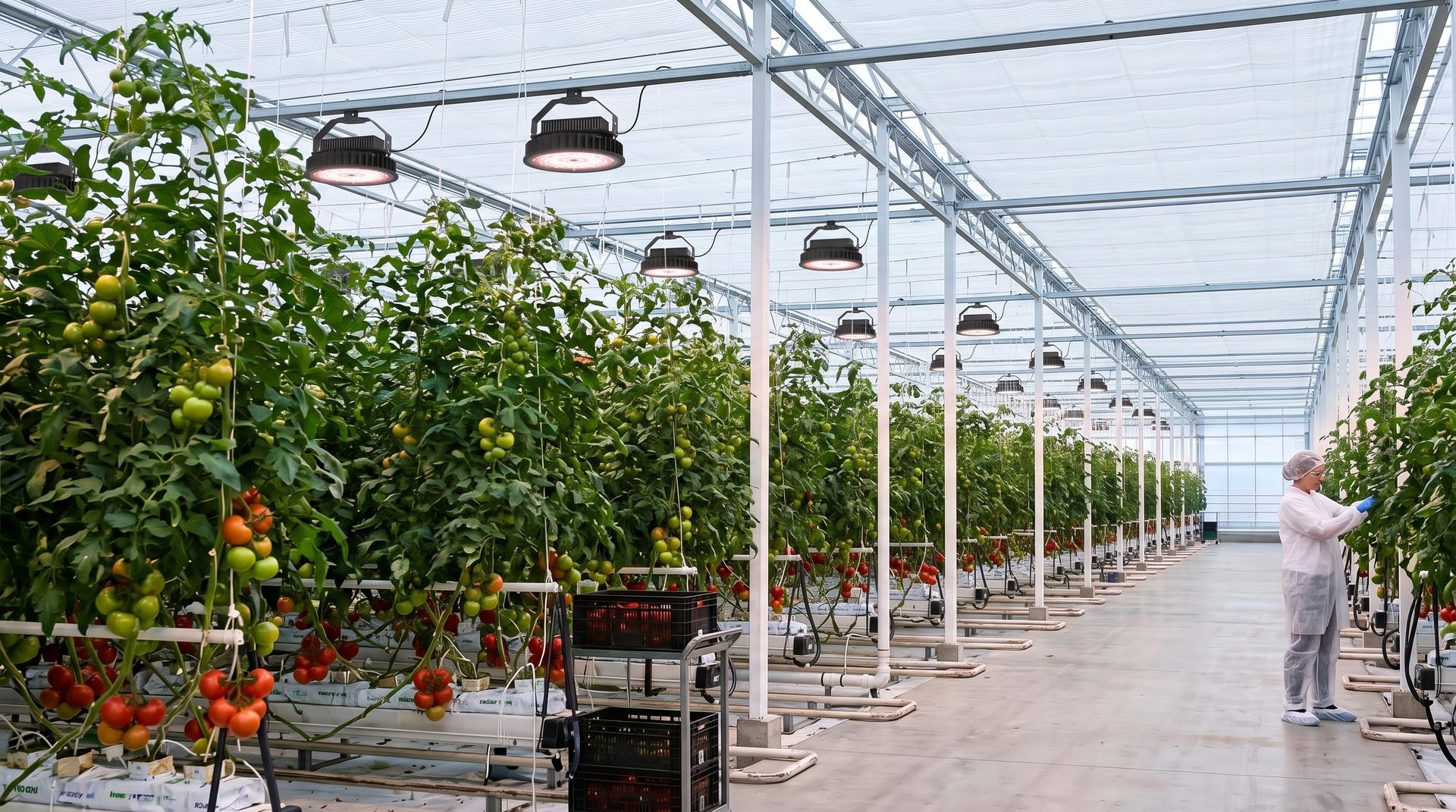
Mass retrofitting of high-pressure sodium lamps with LED grow lights in greenhouse complexes cuts energy costs and increases overall yields. However, in practice, such modernization often reveals hidden plant physiological issues. According to industry publication VerticalFarmDaily, citing data from HortiTech research organization Director Perry van Adrichem, Dutch tomato growers who switched from high-pressure sodium (HPS) lamps to LEDs encountered a distinct winter quality defect: persistent green blotches appear on ripening fruit and never disappear over time, regardless of how long the truss remains on the plant.
Physiological Mechanism of the Ripening Defect
According to HortiTech specialists, blotching is not caused by pathogens or viruses, but is a physiological tissue growth disorder. Under HPS lamps, thermal radiation stimulates active transpiration in the canopy. Moisture evaporation from leaves drives an upward sap flow that delivers dissolved nutrients to developing fruit.
When switching to LED luminaires, radiant heating of the canopy decreases. Simultaneously, greenhouse agronomic and engineering teams keep energy-saving screens tightly closed during dark winter months to conserve heat. Under these conditions, plant transpiration drops significantly, and nutrient uptake slows down. If the nutrient supply is disrupted during fruit filling, the outer cell wall layers expand faster than the inner tissue. This causes uneven filling and internal tissue voids, outwardly appearing as persistent green zones.
Researchers recorded that this ripening disorder is most pronounced in large-fruited hybrids: in tomatoes with an average weight of about 150 grams, the fruit expands extremely rapidly after flowering, and any temporary deficit in upward nutrient flow instantly leads to structural pulp heterogeneity.
Engineering Solutions to Restore Evaporation
To find a balance between energy conservation and produce quality, HortiTech conducted comparative trials across four isolated compartments on Macxize and Showvine hybrids under identical baseline microclimate settings. The control baseline included a compartment with standard HPS lamps (high energy consumption, intensive evaporation, low blotching, but lower total yield) and a standard compartment with typical LED modules (high gross yield, but pronounced fruit blotching).
Two other trial compartments tested active microclimate management:
- LED luminaires with integrated fans. Modules with built-in forced airflow direct heat from heatsinks downward directly into the upper canopy and top trusses. This heat redistribution warms plants and stimulates evaporation. According to trial data, this approach reduced heating gas consumption by 30% compared to the HPS control compartment, while delivering a 30–40% increase in tomato yield and a notable reduction in blotching defects relative to standard LED.
- Column forced ventilation. Distributed ventilation columns were installed in the compartment to draw dry air from the overhead attic space above thermal screens and supply it to the active crop canopy. With screens closed, this reduces humidity around leaves and stimulates transpiration flow without overheating the upper canopy level.
Although none of the tested engineering solutions completely eliminated the blotching issue, both forced air circulation options significantly improved product marketability compared to static LED supplemental lighting.
Implications for Russian Greenhouse Complexes
When retrofitting existing facilities and designing new protected cultivation projects, the main error made by agronomic and engineering teams is calculating photons directly without adjusting the thermal envelope. When developing tomato supplemental lighting projects, it is critical to recognize that completely eliminating infrared radiation from sodium lamps alters the thermal balance of leaves and trusses.
Under the cold climate of Russian regions and prolonged winter periods, thermal screens stay closed for weeks. With low transpiration, even a balanced nutrient solution fails to reach rapidly growing tissues in required volumes. Consequently, after achieving nominal kilowatt-hour electricity savings, a greenhouse facility faces a drop in Grade 1 fruit yield and lower revenue.
To prevent physiological disorders when designing supplemental lighting and ventilation, specialists recommend:
- Evaluating not only PAR levels and photosynthetic photon flux density, but also the temperature balance in the flowering and fruit-filling canopy zone, consulting practical guides on tomato supplemental lighting.
- Providing active air circulation and dehumidification under closed energy screens using under-screen ventilation or recirculation units.
- Adjusting target temperatures for grow pipes and inter-row heating loops (vegetative heating) to locally stimulate evaporation in lower and middle leaf layers under solid-state luminaires.
- Adapting fertigation recipes and irrigation strategies to lower transpiration during peak supplemental lighting operational periods.