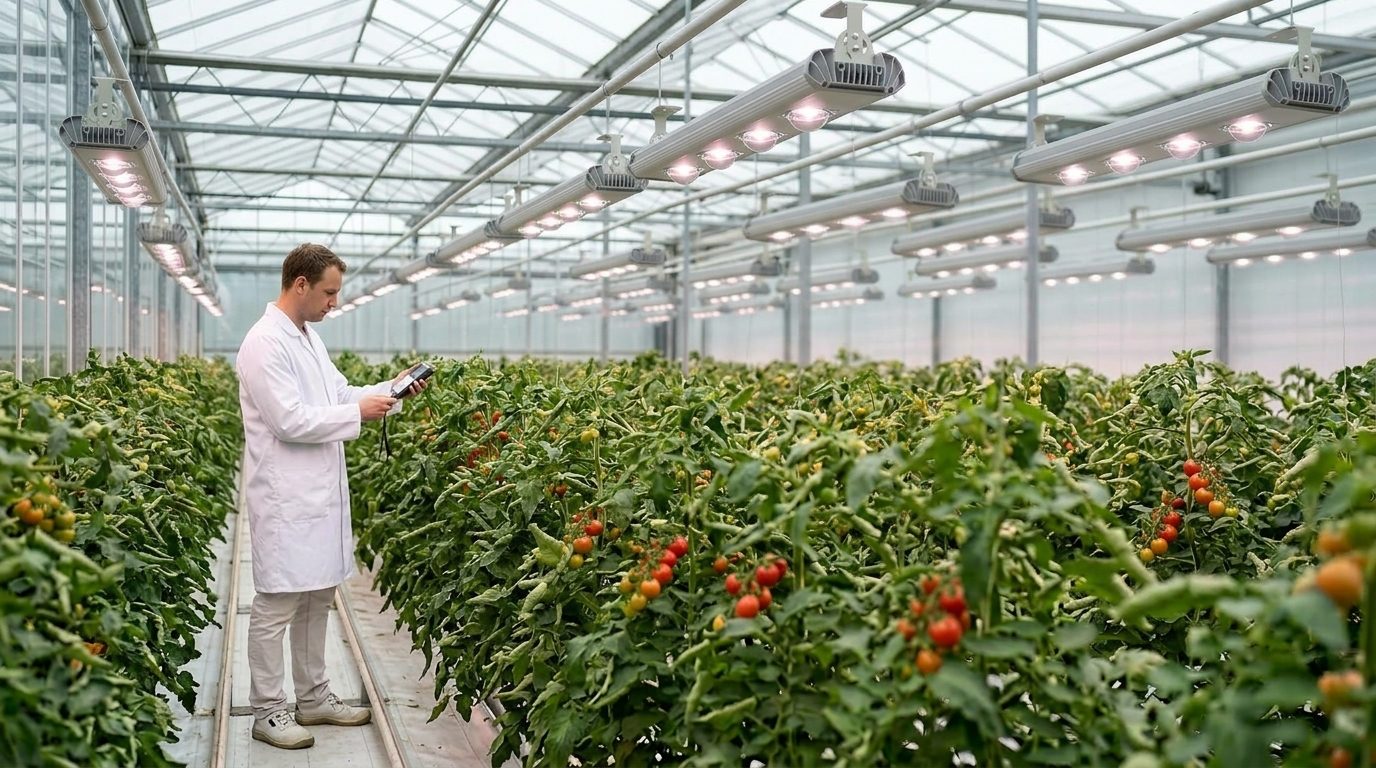
Multi-Channel LED Grow Lights: Spectrum Sensors and Greenhouse Automation
The advancement of protected cultivation technologies presents agronomic and engineering teams with the question of whether dynamic spectral control is feasible. Unlike single-channel fixtures, which only allow intensity adjustments, multi-channel LED luminaires make it possible to continuously adjust the ratio between spectral bands—specifically red, blue, green, and far-red light. This allows growers to tailor the light recipe to the crop, developmental stage, or growing technique, but simultaneously increases the hardware and digital complexity of the greenhouse facility.
Instrumental Monitoring of the Light Environment
Fully realizing the potential of multi-channel equipment requires continuous instrumental monitoring of actual light output. According to NLight, spectrum sensors measure the exact composition of the light, while PAR sensors record photosynthetically active radiation levels, providing the control platform with data for adjustments. Without these measurements, the system cannot respond flexibly to external changes or maintain target lighting parameters.
As Joost van Rooij, Head of European Operations at NLight, notes, continuous monitoring with sensors is an absolute necessity for effective light control, as manual spectrum checks are not feasible in practice. Based on continuously incoming data, the control platform continuously translates sensor data into channel-specific fixture adjustments to maintain the light recipe as external conditions change throughout the photoperiod.
Technology Assessment for Commercial Facilities
For the head agronomist, implementing dynamic spectral control provides the ability to guide plant morphogenesis and switch lighting regimes between vegetative and generative phases. Transitioning to multi-channel lighting requires a balanced engineering assessment: the increased complexity of luminaire design with multiple independent power channels and drivers leads to higher capital expenditures for the lighting installation.
For the chief engineer and facility designer, control architecture becomes the key factor. Automatic per-channel regulation requires integrating specialized spectrum and PAR sensors into the central climate computer or laying a dedicated control bus. When evaluating operational reliability, it is critical to account for the performance stability of optical sensors under high humidity and greenhouse dust conditions, as well as their calibration intervals. Practical examples of LED deployments in commercial facilities can be explored in the case study on how an agricultural enterprise evaluated cucumber supplemental lighting trials.
Application Limits and Practical Takeaways
Deploying multi-channel systems during winter crop cycles has clear technological boundaries. In periods of minimal natural solar radiation, fixtures operate at full power, and the spectral composition of total incoming light is almost entirely determined by the artificial source. In this situation, the need for continuous spectral dimming throughout the day decreases compared to transitional spring periods, when natural insolation dynamically alters total canopy irradiance.
When designing retrofits or constructing new greenhouse compartments, technical teams are advised to:
- Assess whether a fixed spectral recipe is sufficient for a given monoculture before ordering multi-channel luminaires.
- When selecting dynamic control systems, balance the installation and maintenance costs of spectrum and PAR sensors against the expected agronomic return.
- Verify compatibility between multi-channel driver control protocols and the greenhouse climate computer.
Field experience with adapting dedicated spectrum solutions across crops is also discussed in the article on four luminaire configurations for diverse growing scenarios.
Sources