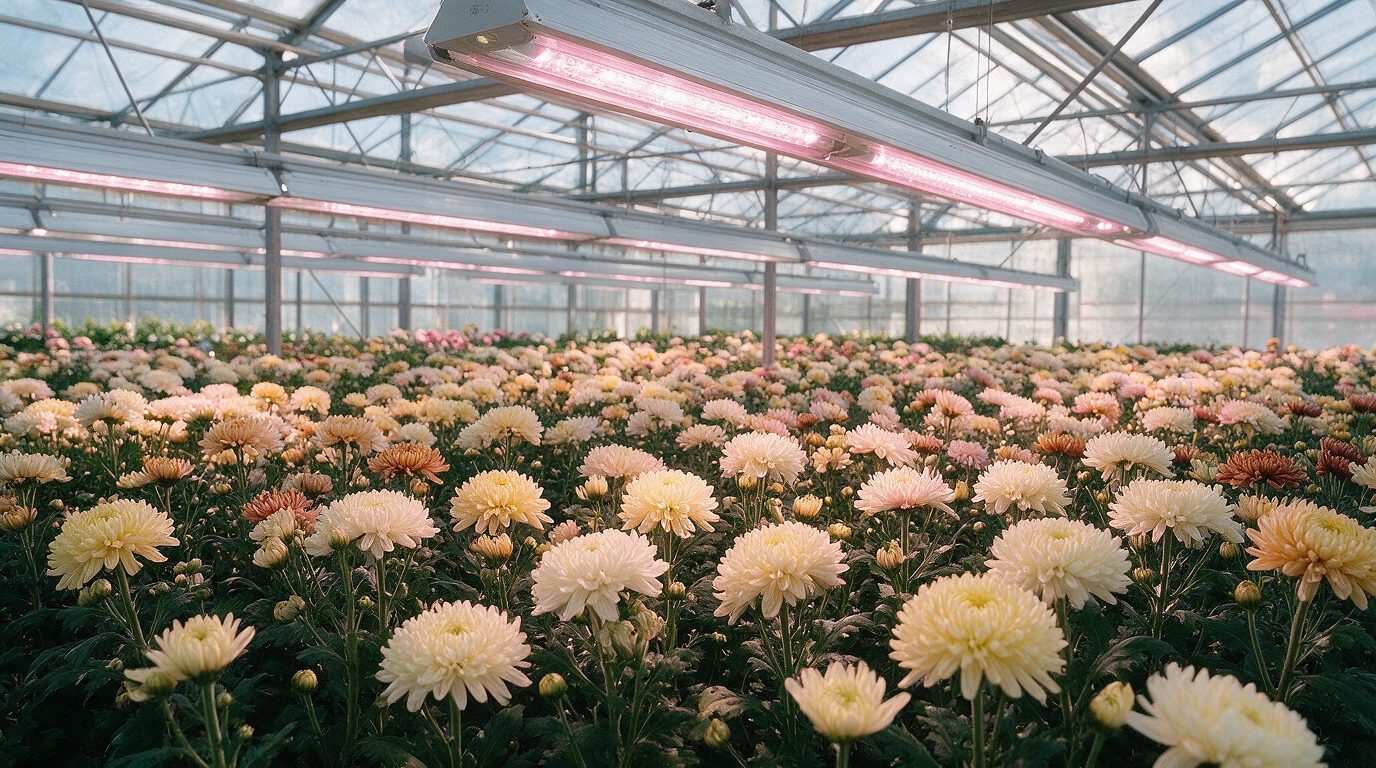
Chrysanthemum Flowering Control: Impact of PPFD, Photoperiod, and Vernalization
Managing bud initiation timing and opening rates determines the economics of year-round cut flower production in protected cultivation. Researchers published multi-factorial trial data on garden chrysanthemum (Chrysanthemum morifolium cv. «Xiaokuixiang») in Frontiers in Plant Science. The study outlines exact light intensity thresholds, dark period lengths, and low-temperature treatment regimes required to accelerate the transition from vegetative to generative phase.
Trial Parameters and Bud Initiation Dynamics
The experiment was conducted in a climate chamber with temperature maintained at 21–23 °C. Plants underwent a 45-day vegetative stage under long-day conditions (16 hours light and 8 hours dark). Four photosynthetic photon flux density levels were tested: 50, 100, 200, and 300 μmol/(m²·s).
Supplemental lighting intensity directly affected apical meristem differentiation rates:
- At PPFD 300 μmol/(m²·s), visible bud initiation occurred on average 27 days after planting.
- At PPFD 200 μmol/(m²·s), buds formed after 28 days.
- Reducing the level to 100 μmol/(m²·s) pushed initiation back to 42 days.
- At the minimum level of 50 μmol/(m²·s), initiation occurred only after 40–42 days, with plants developing fewer viable flower buds, stretching, and forming excessive internode length.
Gene expression analysis confirmed that increasing PAR to 300 μmol/(m²·s) significantly upregulates key florigen pathway genes—CmFTL3, CmSOC1, and CmGA20ox1—in apical buds and leaves.
Photoperiodic Control and Temperature Induction
To transition to active bud formation, the crop requires short-day conditions. Testing four photoperiod regimes (light/dark 8/16, 10/14, 12/12, and 16/8 hours) confirmed the cultivar is facultatively short-day. Plants need at least 12 hours of continuous darkness to trigger differentiation, while an 8-hour light / 16-hour dark schedule delivers maximum flowering rate and synchrony. Under long-day conditions (16/8), underdeveloped, abortive buds measuring 1–3 mm appeared and ceased development.
Vernalization of shoots at 4 °C for 1 to 5 weeks (treatments LT1 through LT5) reduced the subsequent vegetative stage duration after transfer to standard temperature conditions of 22–24 °C. When plants reached a height of 26 cm, switching to an 8/16 photoperiod produced the highest number of marketable flowers specifically in groups subjected to cold pre-treatment.
Implications for Year-Round Protected Cultivation
In commercial greenhouse complexes during autumn and winter, natural solar radiation drops to a minimum. If the supplemental lighting system delivers less than 100 μmol/(m²·s) to the canopy, the cut-flower production cycle lengthens by 13–14 days per turn. This increases heating costs and lowers cultivation area turnover.
Maintaining an uninterrupted harvesting conveyor requires transitioning to PPFD levels around 200–300 μmol/(m²·s) in the upper and middle canopy layers. When designing greenhouse supplemental lighting systems, precise PAR calculations determine flowering schedules; layout examples for demanding crops can be found in the article on supplemental lighting for diverse plant collections.
At the same time, growers must strictly monitor the light-tightness of blackout screens. The 12–16 hour darkness threshold tolerates zero light pollution from adjacent compartments or external sources: light leaks during the dark phase suppress florigen synthesis.
Study Limitations
The experiment was conducted on a single chrysanthemum cultivar («Xiaokuixiang») belonging to the aromatic group. Critical day length sensitivity in cut-flower cultivars from Dutch and domestic breeding varies from 10 to 13 hours; therefore, lighting schedules must be calibrated for each specific cultivar. Furthermore, measurements were taken in an enclosed climate chamber with stable microclimate conditions, without accounting for natural DLI fluctuations and spectral variations typical of glass greenhouses.
Agronomic Recommendations
For year-round chrysanthemum scheduling, the technological process is divided into two controlled phases. During the vegetative phase, maintain a long-day photoperiod (16 hours light) with PPFD of at least 200 μmol/(m²·s) to prevent stem elongation and promote biomass accumulation. During the flower induction phase, blackout screening should ensure 14 to 16 hours of continuous darkness, while maintaining supplemental lighting intensity at 200–300 μmol/(m²·s) during the remaining light hours.