Winter Strawberry LED Lighting: Spectrum Economics & Yield
The Harrow Research and Development Centre (Agriculture and Agri-Food Canada) has published the results of an experiment evaluating the effects of supplemental LED spectral composition and irrigation electrical conductivity (EC) on yield, fruit biochemical parameters, and direct electricity costs in protected winter strawberry cultivation. The findings target commercial greenhouse facilities establishing year-round berry production under low natural solar radiation.
Experimental Parameters and Spectral Treatments
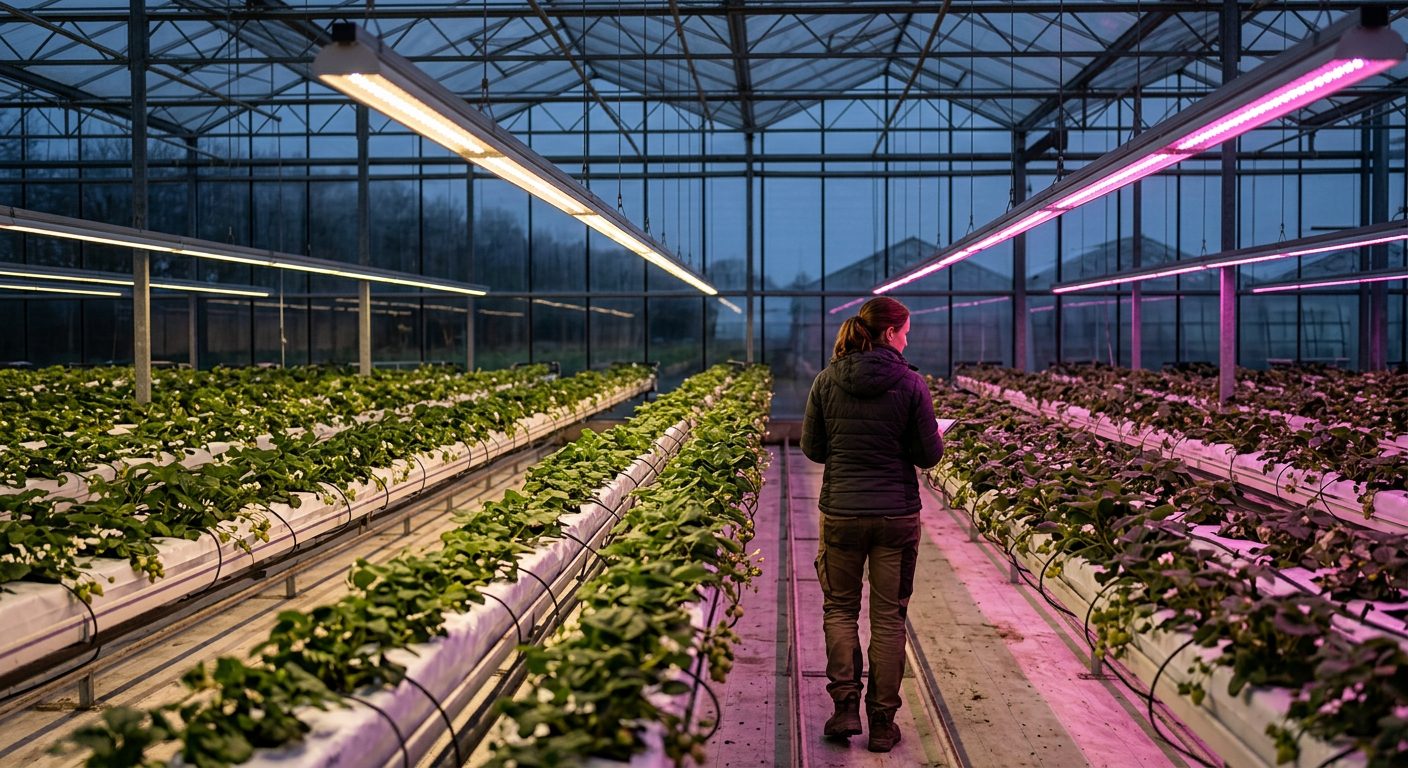
The trial was conducted in a glass greenhouse during the 2023–2024 winter season on two day-neutral cultivars, Albion and Favori. Plants were grown using substrate hydroponics in rockwool slabs. The experimental setup compared four top lighting LED treatments:
- red-blue spectrum dominated by the red band (95% red, narrow-band red-rich);
- pink spectrum;
- warm white spectrum;
- neutral white spectrum with green radiation exceeding 24%.
Lighting treatments were combined with two electrical conductivity levels in drip irrigation nutrient solution: standard (EC = 2 mS/cm) and elevated (EC = 3 mS/cm). Supplemental lighting accounts for up to 30% of greenhouse operational expenses in winter, making electricity consumption per kilogram of marketable fruit the primary evaluation metric.
Effects of Spectrum on Photosynthesis, Yield, and Fruit Quality
Under broadband spectra, plants exhibited higher net photosynthetic rates and accumulated greater vegetative biomass compared to narrow-band red-blue light. However, increasing green wavebands beyond 24% (white spectrum treatment) suppressed photosynthetic activity and decreased biomass gain.
Despite differences in canopy development and CO₂ assimilation rates, final marketable fruit yields for both cultivars showed no statistically significant dependence on luminaire spectral composition or fertigation electrical conductivity within the 2 to 3 mS/cm range.
Fruit quality parameters responded differently to spectral quality: berries grown under pink and warm white light had lower titratable acidity (TA) and a higher soluble solids-to-acid ratio (Brix/TA), which improves dessert fruit flavor profile. Under red-blue spectrum, fruits maintained standard organoleptic parameters typical of the cultivars.
Energy Efficiency and Cost per Kilogram of Production
The decisive factor for commercial economics is luminaire photosynthetic photon efficacy (PPE, μmol/J). Due to the physical efficiency of direct red LEDs, the narrow-band red-blue spectrum (95% red) delivered maximum photon output per kilowatt-hour consumed.
Direct cost calculations showed that red-dominant fixtures achieve the lowest electricity cost per kilogram of marketable fruit while maintaining yields equal to broadband alternatives. Increasing white and green spectral components lowers luminaire efficacy and increases energy consumption per unit of harvested crop without providing compensatory yield gains.
Implications for Commercial Greenhouse Operations
For year-round greenhouse complexes in northern and temperate latitudes, electricity costs represent a major share of berry production costs from November through March. Natural daylight at latitudes above 55° contributes minimally to the daily light integral (DLI) during winter months, requiring grow lights to operate over an extended photoperiod.
The trial demonstrates that attempting to stimulate strawberry yields through spectral complexity and broad white bands is economically unjustified: yields do not increase, while system power consumption rises. Similar trends are confirmed across other crops: see how Agroholding Dobryanskiy summarized trial results on cucumber, where photon efficacy optimization helped reduce connected power load.
For winter greenhouse and hydroponic berry production lines, it is practical to separate objectives: base photon delivery for photosynthesis is most efficiently supplied by red-dominant luminaires, minimizing transformer substation loads and captive generation demands. Supplemental lighting deployment under challenging climate conditions is also illustrated in another project: supplemental lighting in a winter greenhouse in Tavatuy, Sverdlovsk Region.
Study Limitations
When transferring these findings to commercial operational planning, several experimental boundary conditions should be considered:
- The trial was conducted over a single winter season (2023–2024) in a research greenhouse located in the Harrow climate zone (southern Ontario).
- The study was limited to two day-neutral cultivars (Albion and Favori) on rockwool substrate; short-day cultivars may respond differently.
- Fertigation salinity was evaluated only within the EC 2–3 mS/cm range; the effects of lower or higher EC levels were not assessed.
- Cost assessments evaluated direct lighting electricity consumption without factoring luminaire thermal dissipation into overall greenhouse heat balance.
Key Takeaways for Agronomists and Greenhouse Engineers
When engineering and retrofitting winter strawberry lighting installations, the following aspects should be prioritized:
- Prioritize electrical efficacy: luminaires with maximum PPE (red-blue modules with ~95% red) deliver the lowest electricity cost per kilogram of winter fruit.
- Limit broad-spectrum components: white LEDs with green band shares exceeding 24% reduce photosynthetic efficiency and increase required electrical capacity without yielding additional crop.
- Manage fruit quality: if retail specifications demand a higher sugar-acid index (Brix/TA), incorporating targeted warm white spectra provides a flavor tuning tool, albeit at higher lighting operating costs.
Sources