LED Light Spectrum for Tomatoes: Controlling Nitrates and Acidity
Tomato Phenotype Restructuring Under Different Spectral Compositions
A research group led by A. S. Turbekova (Eurasian Agrotechnical Journal, DOI: 10.51452/eaj.2026.2(130).2195) evaluated the effect of grow light spectral composition on canopy architecture, metabolism, and biochemical parameters of tomato fruits. The study demonstrated that at identical photosynthetic photon flux density (PPFD) levels, spectral composition acts as a direct regulator of assimilates partitioning and metabolic priorities in the crop.
Rather than evaluating yield in isolation, the authors used multidimensional analysis of coordinated traits. The experiment showed that the emission spectrum shapes distinct phenotypic strategies: from expanding assimilation leaf area to altering the accumulation of sugars and organic acids.
Experimental Parameters and Measured Shifts
The experiment compared two LED spectral compositions under identical supplemental lighting intensity:
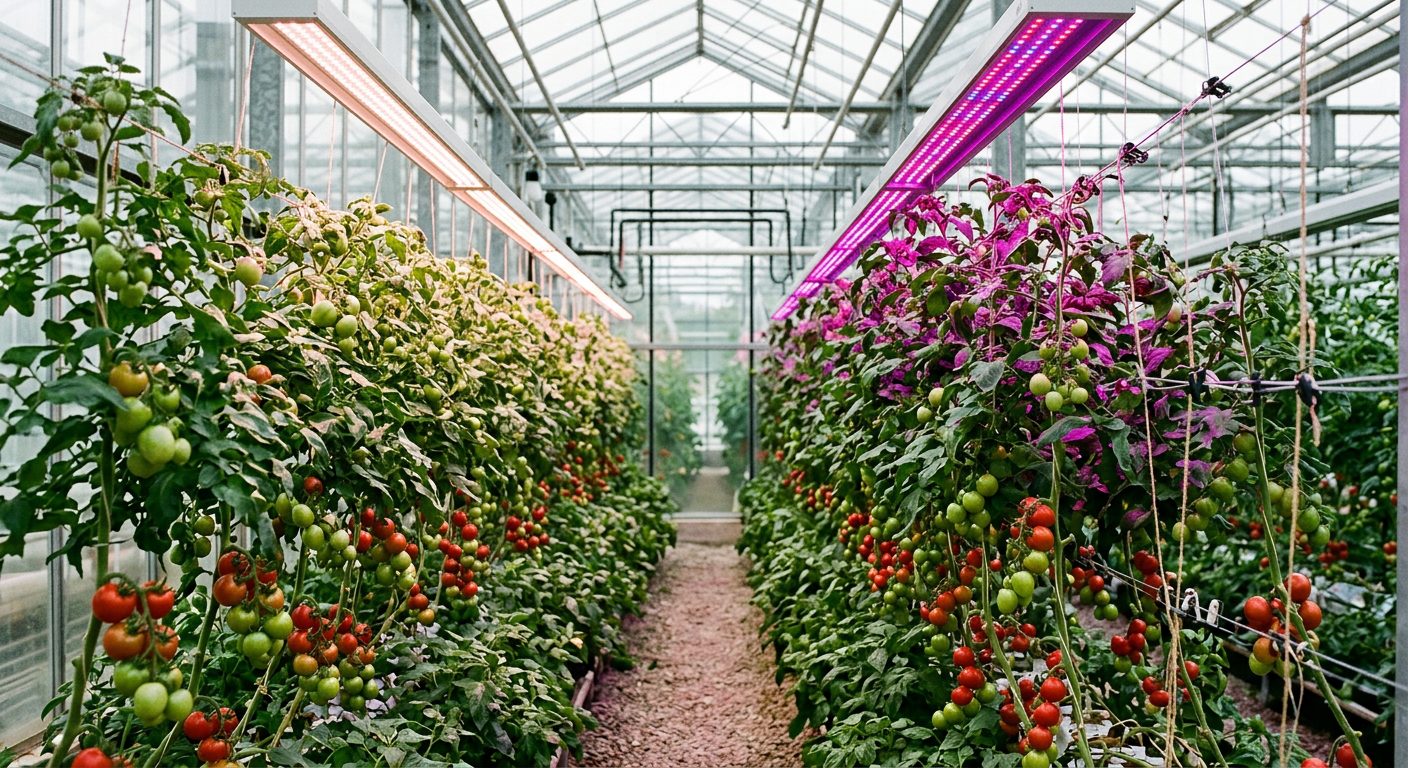
- Predominantly red spectrum (KSDO2) produced a phenotype geared toward maximum productivity. The plants exhibited vigorous leaf area expansion and accelerated nitrogen assimilation. At the same time, nitrate content in tomato fruits decreased.
- Balanced spectrum (KSDO1) shifted metabolism toward steady accumulation of pigments and organic compounds. Titratable acidity of tomato fruits increased by 18.7%, improving organoleptic qualities and flavor balance.
Correlation analysis revealed a tight link between canopy density, nitrogen nutrition, and the accumulation of antioxidant compounds. The plant's metabolic balance shifts either toward forced biomass synthesis or toward the accumulation of dry matter and acids.
Significance of Spectral Optimization for Russian Protected Cultivation
Under short winter daylengths and low natural solar radiation across central and northern latitudes of Russia, greenhouse tomato crops rely heavily on artificial lighting within their daily light integral (DLI) structure. In such conditions, supplemental lighting spectrum ceases to be a secondary factor and begins to define plant habit throughout the entire crop cycle.
Shifting toward the red spectrum provides a technological advantage during periods of minimal natural PAR availability: it allows for faster leaf area expansion and reduces fruit nitrate load during intensive fertigation and nitrogen feeding. Similar patterns of spectral effects on canopy development are confirmed by examples of lighting zoning in research practice.
At the same time, a monochromatic focus on yield without balancing blue and green components can lead to reduced flavor metrics, specifically titratable acidity, which is critical for packaged produce supplied to retail chains. Commercial greenhouse trials, including the experience of light regime optimization in industrial greenhouses, show that aligning the spectrum with agronomic goals directly determines the return on energy costs.
Study Limitations
The authors formulated their conclusions based on a multidimensional mathematical model of trait integration under controlled conditions. The study investigated specific spectral variants, KSDO1 and KSDO2. Applying complex phenotypic models to commercial greenhouses requires taking into account cultivar specifics, trellis height, and mutual shading in dense high-wire crop canopies.
Key Takeaways for Specialists
- For the head agronomist: grow light spectral composition enables targeted crop quality management. When facing winter nitrate accumulation risks, a spectrum with an increased red fraction is effective, whereas enhancing flavor and titratable acidity requires a balanced polychromatic spectrum.
- For the lighting designer: selecting LED modules for tomato supplemental lighting should rely not only on nominal efficacy in μmol/J, but also on the commercial grower's technological objectives: maximizing gross yield or producing premium fruit with specified flavor characteristics.