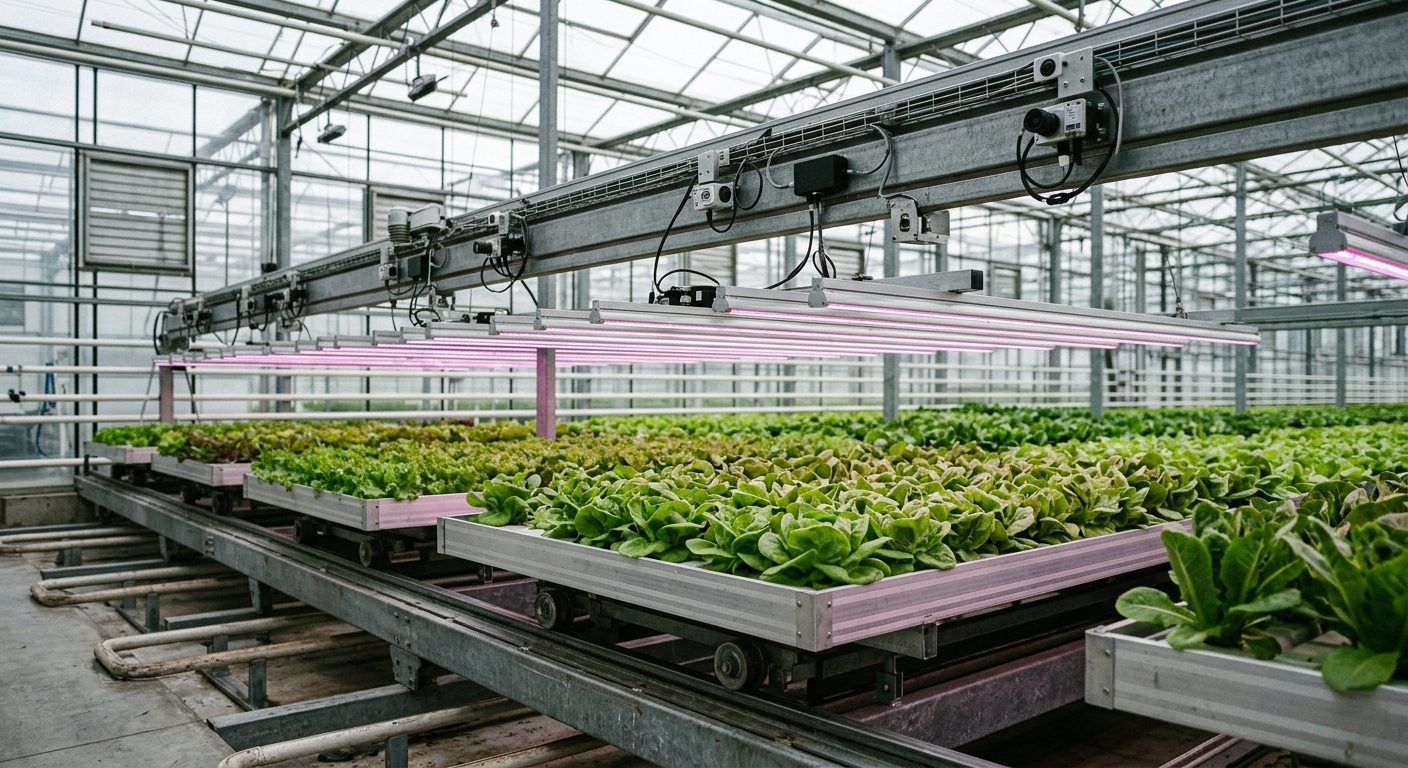
Chlorophyll Fluorescence Dynamic Control for Greenhouse LED Lighting
Researchers from the University of Georgia evaluated a dynamic LED supplemental lighting control system based on plant photochemical activity parameters. The algorithm relies on measurements of photosystem II quantum yield (ΦPSII) from chlorophyll fluorescence sensors and a multiple linear regression mathematical model predicting crop physiological status from microclimate parameters.
Sensor Control vs. Predictive Models
Conventional greenhouse automation algorithms target daily light integral (DLI) or natural solar radiation thresholds. Under these schemes, grow lights operate at fixed output or stepped dimming without accounting for real-time electron transport rates in leaves. When photosystems saturate, excess photon flux cannot be utilized by the crop and dissipates as heat, leading to wasted electricity.
In a glass greenhouse experiment, three LED supplemental lighting control strategies were evaluated on lettuce:
- constant photosynthetic photon flux density (PPFD);
- direct real-time control driven by an optical fluorometer signal;
- predictive control based on a machine learning regression model.
The model calculated the photosystem II quantum yield from six input parameters: background light intensity, CO2 concentration, air temperature, vapor pressure deficit (VPD), prior light history, and circadian rhythms. Both adaptive approaches stabilized plant photochemical activity throughout the photoperiod. With equal biomass accumulation across all treatments, the highest supplemental lighting Energy Use Efficiency was achieved by the closed-loop system using direct chlorophyll fluorescence measurements.
Significance for Design and Operation in Russian Facilities
For Russian commercial greenhouse complexes in light zones with short winter days and high energy cost shares in production, saving every kilowatt-hour remains a priority. Direct transfer of laboratory optical systems to commercial operations encounters practical hurdles:
- Hardware reliability of sensing modules. Laboratory-grade optical fluorometers are sensitive to dust, condensation, crop protection sprays, and mechanical damage during maintenance operations.
- Canopy spatial heterogeneity. A sensor captures the status of a single leaf at a specific height level. On high-wire crops (tomato, cucumber), light field distribution across the vertical trellis profile requires a distributed sensor network, complicating cabling or wireless infrastructure.
- Integration into process control systems. Most climate computers operate on proprietary protocols and do not support third-party predictive scripts directly. Dynamic luminaire dimming requires digital interfaces (0–10V, DALI, or Modbus) and controllers capable of recalculating setpoints in real time.
Using indirect mathematical models based on standard microclimate sensors (temperature, humidity, CO2, pyranometers) is technically more accessible for operating facilities. This approach eliminates the need to mount fragile optical sensors on plants while retaining the benefits of adaptive supplemental lighting control.
Study Limitations
The study was conducted on leaf lettuce, which features a relatively simple canopy architecture and lower leaf area density compared to high-wire crops. The experiment evaluated monochromatic and combined LED spectra within a single greenhouse growth chamber. The authors did not assess the economic payback of deploying a commercial fluorometer network, accounting for calibration, installation, and ongoing maintenance costs.
Engineering Takeaways
When designing new facilities and retrofitting lighting systems using ECOLED-BIO luminaires, specifying continuous analog or digital dimming instead of stepped group switching is recommended. Shifting to physiology-based adaptive supplemental lighting cuts peak energy demand during hours when the crop experiences photosaturation or temperature stress.
Engineers and system designers should implement such solutions in phases: first adapting climate computer algorithms to incorporate VPD dynamics, temperature, and accumulated light, then fine-tuning setpoints using test optical sensors at benchmark locations within the greenhouse compartment.