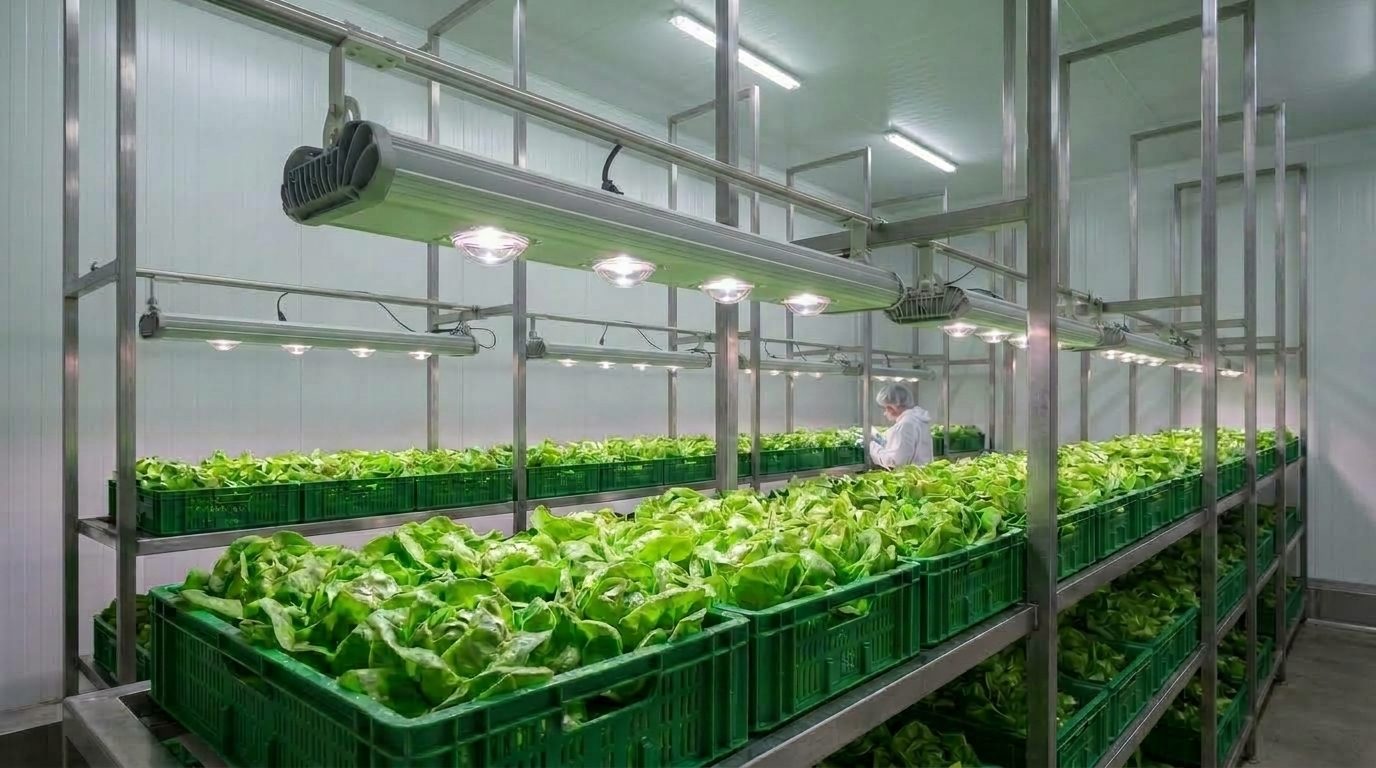
Green Spectrum in Cold Storage: How Lighting Inhibits Lettuce Degradation
Postharvest shelf life of leafy greens remains a critical factor in protected cultivation logistics. After harvest, plant tissues maintain metabolic processes: darkness in holding areas and cold storage triggers rapid chlorophyll degradation, the breakdown of bioactive compounds, and loss of visual marketability. Traditional cold storage in the dark reduces respiration but accelerates leaf senescence.
A research team led by Salehinia in a study published in the journal Horticulturae conducted a detailed evaluation of monochromatic green LEDs on the retention of biochemical compounds and photosynthetic pigments in leafy lettuce at low temperatures.
Experimental Parameters and Light Treatments
The experiment evaluated lettuce storage at 5 °C over 14 days in the dark, under white LEDs, and under green LEDs with peaks at 500 and 530 nm at a constant light intensity of 10 μmol/(m²·s) and a 12-hour photoperiod. The authors analyzed the dynamics of key pigment groups, polyphenols, and total soluble solids compared to initial baseline levels and traditional dark storage.
Unlike red and blue photons, which are absorbed primarily by upper mesophyll layers, green light penetrates deeper into leaf tissue. This enables green light to reach internal plant photoreceptors even at minimal irradiance levels sufficient for signaling regulation of metabolism without excessive energy consumption.
Preservation of Chlorophylls and Photosynthetic Apparatus
Control samples kept in darkness or under broadband white LEDs showed noticeable degradation of the primary photosynthetic pigment over the two-week storage period. Under green light exposure, leaf tissues exhibited a fundamentally different response.
Storage under green LEDs with wavelengths of 500 and 530 nm provided increases in chlorophyll a content of 26.4% and 16.0% respectively, as well as a 65.6% and 46.6% rise in the chlorophyll a/b ratio compared to dark storage. At the same time, the shorter green wavelength showed an advantage in stabilizing the overall pigment pool: green lighting at 500 nm resulted in a 13.5% higher total chlorophyll content compared to dark storage.
Stabilizing chlorophyll a and elevating the Chl a/b ratio directly preserves the rich green leaf color, preventing postharvest yellowing during pre-sale preparation and intermediate distribution.
Accumulation of Protective Pigments and Antioxidants
Beyond chlorophylls, green wavelengths stimulated the synthesis of secondary metabolites responsible for resistance to oxidative stress and the nutritional value of greens. The most pronounced accumulation dynamics of protective compounds were observed under 530 nm light.
Lighting with 530 nm green LEDs yielded an increase in anthocyanin content of 128.2%, carotenoids by 26.2%, and flavonoids by 95% compared to dark storage. Activation of the phenylpropanoid pathway enables the plant tissue to suppress necrotic processes and maintain turgor by stabilizing cell membranes.
The study of spectral treatments across different cultivation and postharvest stages is regularly covered in publications via the industry media center, analyzing the results of LED installations in protected cultivation.
Significance for Greenhouse Logistics
For commercial growers and distribution centers, these experimental results indicate a technical feasibility to extend commercial lettuce freshness without altering warehouse temperature mapping. An irradiance level of 10 μmol/(m²·s) places minimal thermal load on refrigeration equipment, which is critical for maintaining a stable 5 °C regime.
Deploying 500 and 530 nm spectra in packing areas and short-term holding zones achieves two goals:
- slows chlorophyll degradation and loss of visual head freshness;
- enhances the antioxidant profile of the final produce prior to delivery to retail chains.
The principles of precise spectral selection for specific biological objectives apply not only to industrial cultivation units but also to designing laboratory facilities, as shown by the experience of building educational biolabs with specialized lighting.
Implementation Constraints
When considering the deployment of lighting in cold rooms, methodological limitations of the study must be taken into account:
- The experiment was conducted in a laboratory chamber with unobstructed light access to the leaf surface. In commercial practice, lettuce is packed in corrugated boxes, flow-packs, or stacked on pallets, preventing photons from reaching the lower layers.
- The study did not evaluate natural mass loss (shrinkage) dynamics under varying relative humidity levels.
- The effect was examined on a model crop under a fixed 12-hour photoperiod; responses of other leafy greens (arugula, spinach, basil) require separate validation.
Practical Takeaways for Agronomists and Engineers
When upgrading storage and dispatch areas, chief agronomists and facility managers should consider:
- Evaluating rack layout in shipping areas: supplemental green lighting is effective only with direct light exposure on open or transparent consumer packaging.
- Calculating the energy balance: at an intensity of 10 μmol/(m²·s), luminaire electrical draw will not overload the cooling unit if energy-efficient LED modules with remote drivers outside the refrigerated zone are used.
- Running a trial storage batch of lettuce under 500–530 nm lighting to benchmark market appearance retention on days 7–14 of storage.
Sources