Green Light Fraction in Lettuce Cultivation: Impact on Biomass and Nitrates
Partial Replacement Experiment of Red-Blue Spectrum
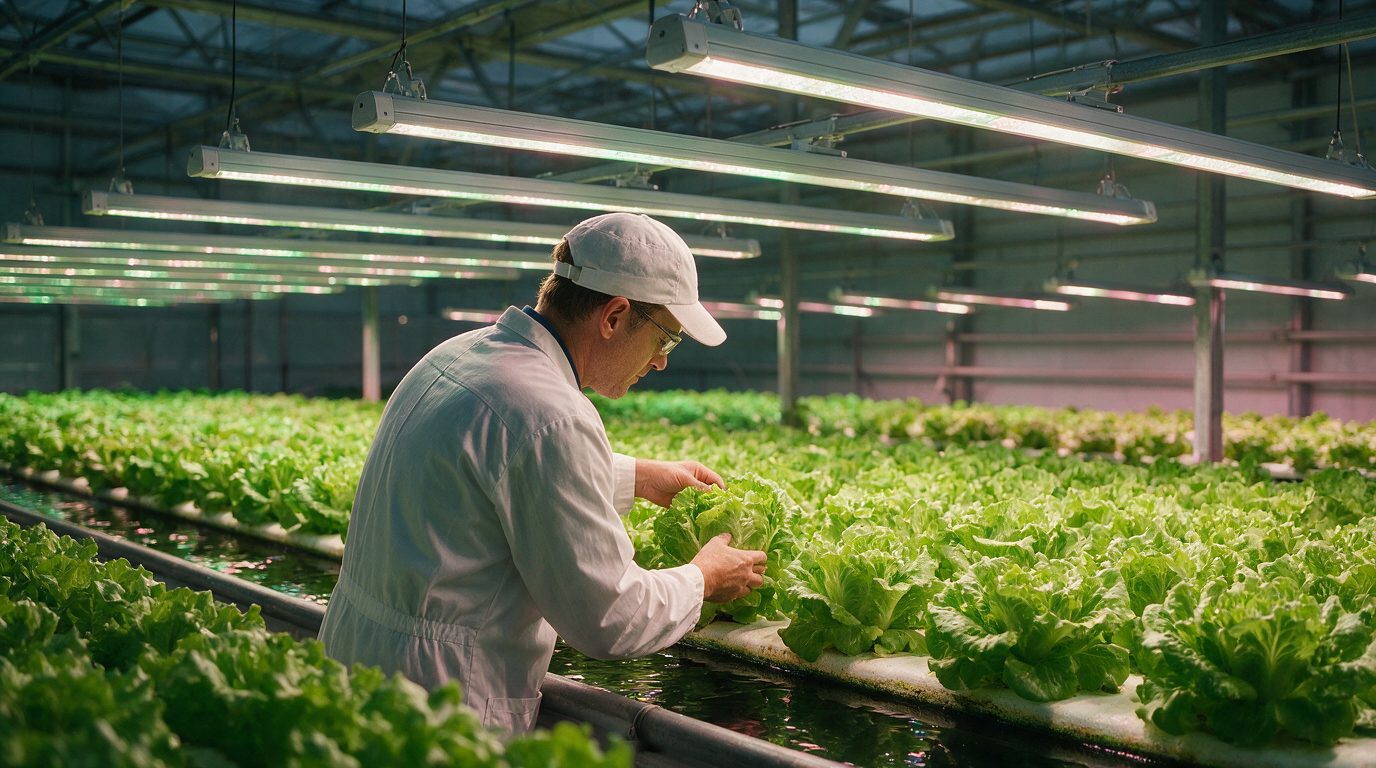
Researchers evaluated the response of hydroponic lettuce to the inclusion of green light in a conventional red-blue spectrum. The trial was conducted under sole-source lighting in a deep flow technique (DFT) hydroponic system. A 60:40 red-to-blue spectrum at a PPFD of 350 μmol/(m²·s) served as the control. In three experimental treatments, light was partially replaced with green light at 10%, 20%, and 40% of the total photon flux while maintaining the overall density at 350 μmol/(m²·s).
The study evaluated photosynthetic parameters, biomass accumulation dynamics, tissue mineral composition, and biochemical crop quality. Lighting regime parameters for lettuce cultivars are discussed in supplemental lighting for lettuce and leafy greens.
Productivity Dynamics and Biochemical Parameters
The greatest vegetative yield increase occurred in the treatment with a 40% green light fraction. Compared to the red-blue control, plant fresh weight increased by 33.16% and dry weight by 21.4%. Nutritional quality indicators improved simultaneously: soluble sugar content rose by 61.79%, while vitamin C concentration increased by 13.43%. Nitrate content in tissues decreased by 16.31% relative to the control.
A different metabolic pathway was observed at a moderate green light fraction. The 10% replacement treatment stimulated the synthesis of protective compounds: flavonoid concentration increased by 148.61%, and polyphenol content grew by 81.24%. The 20% replacement treatment yielded intermediate results, falling short of the maximum level in fresh weight.
Physiological Mechanisms of Photon Absorption
All treatments with added green spectrum resulted in higher net photosynthetic rates and transpiration intensity alongside reduced stomatal conductance and intercellular carbon dioxide concentration. Historically, green light was considered poorly utilized by chlorophyll due to the low absorption coefficient of the isolated pigment. However, in a dense canopy, red and blue photons are absorbed almost entirely by the upper mesophyll layers, whereas green light penetrates deeper through the leaf blade to reach lower cell layers.
Even distribution of energy across leaf thickness prevents light saturation of upper chloroplasts and activates photosynthesis in inner tissues. Furthermore, green radiation stimulated macronutrient uptake: the 40% fraction treatment demonstrated the highest total mineral accumulation in shoot tissues, along with accelerated phosphorus and magnesium uptake.
Relevance for Hydroponic Facilities and Indoor Farming
For commercial automated lettuce systems and multi-tier installations, spectrum selection directly determines marketable yield per square meter. Completed leafy greens lighting projects indicate that narrow-band red-blue modules cause visual fatigue for staff and can induce leaf tip burn under high irradiance levels.
Incorporating green wavelengths into commercial horticultural luminaires accomplishes two objectives: it optimizes canopy light interception architecture and creates a visually comfortable optical environment for crop inspection. A 16.31% reduction in nitrates without compromising biomass accumulation provides an operational margin when balancing nutrient solution nitrogen during peak growth phases.
Limitations of the Experimental Study
The experiment was conducted in an indoor facility using a deep flow technique (DFT) hydroponic system. In vertical farms and commercial greenhouses utilizing nutrient film technique (NFT), root zone hydrodynamics and microclimate humidity distribution differ from DFT systems. In addition, the research was conducted on a single lettuce cultivar at a fixed PPFD of 350 μmol/(m²·s), which requires spectrum validation under varying lighting intensities.
Conclusions for Agronomists
The findings provide guidance for selecting LED grow lights tailored to specific production goals:
- To maximize total yield and reduce nitrate accumulation in hydroponic lettuce, luminaires with approximately 40% green spectrum of the total photon flux are recommended.
- To produce crops with enhanced antioxidant activity (elevated polyphenol and flavonoid content), limiting the green light fraction to 10% is more effective.
- When upgrading lighting on racking and hydroponic lines, optical design should account for a target PPFD of 350 μmol/(m²·s) and spatial light penetration across the developing plant canopy.
Sources