Far-Red Spectrum and In Vitro Potato Morphogenesis: Trial Results
The efficiency of primary potato seed production directly depends on the rate of vegetative mass accumulation by microplants during the in vitro culture stage. Researcher S. V. Shcherbenok (Perm Research Institute of Agriculture — Branch of PFRC UB RAS, Perm SATU) investigated the effect of radiation spectral composition on the morphometric parameters of meristem potato plants in a phytotron. The study results were published in the journal "Agrarian Science".
Methodology and Cultivation Conditions for Meristem Plantlets
The experiment on growing potato plants of cultivars Grand and Julia in vitro on Murashige–Skoog agar medium was conducted for 28 days under a 16-hour photoperiod. The initial planting material was obtained by cutting propagation.
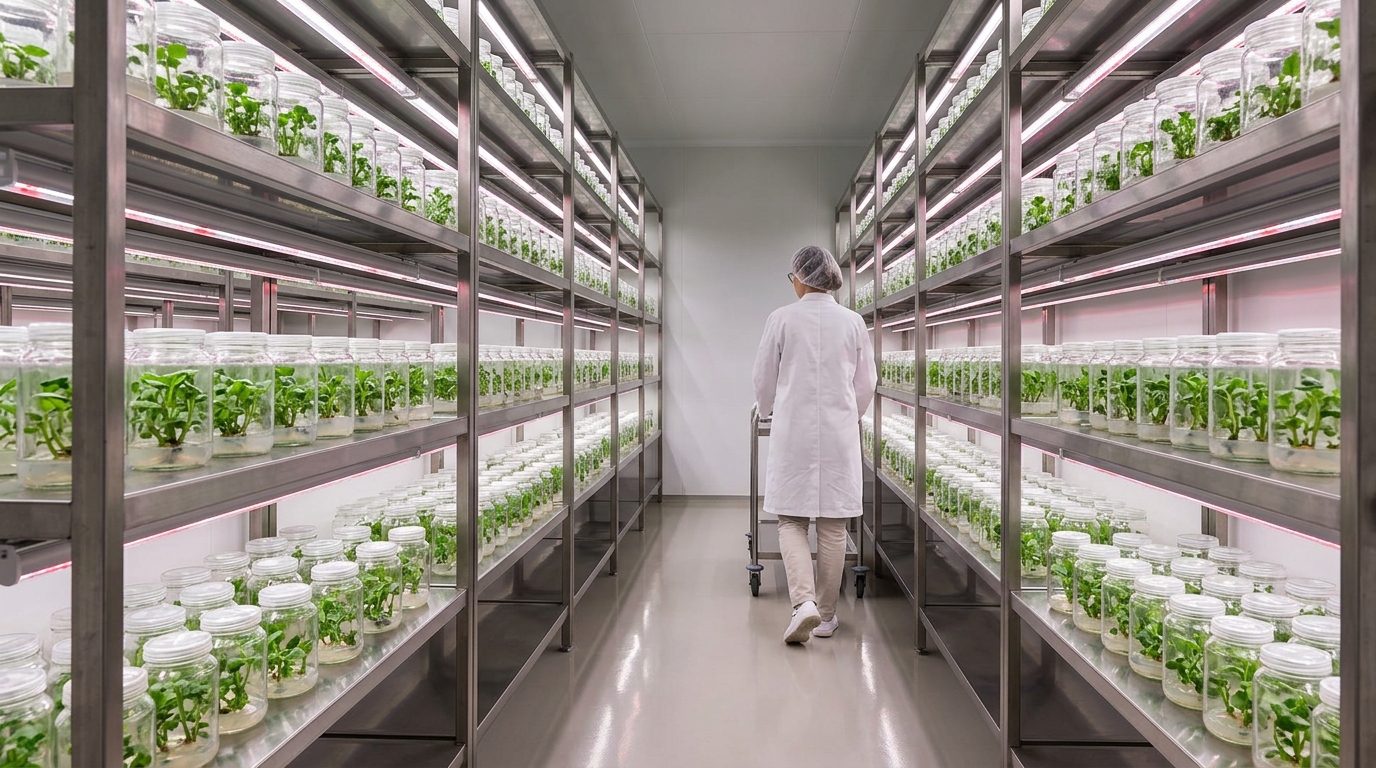
To evaluate the spectral factor, the phytotron was divided into two isolated sectors. In the phytotron experiment, the red to far-red light ratio (R/FR) was 9.9 in the control and 0.5 in the experimental sector with supplementary 730 nm LEDs. The control sector was equipped with baseline LED lighting, whereas in the experimental block, the spectrum was modified with radiation peaking at 730 nm, shifting the balance of phytochrome photoequilibrium.
After completing the cultivation cycle, the plantlets were removed from the test tubes and scanned. Digitized images were processed in ImageJ software to determine shoot length, number of internodes, and assimilatory surface area, while fresh biomass was recorded gravimetrically.
Morphometric Response and Biomass Redistribution
Shifting the spectral balance toward the far-red region triggered a pronounced physiological response in both studied genotypes. Under supplementary far-red light, the leaf area of in vitro potato plants increased by 54.9% in cultivar Grand and by 32% in cultivar Julia compared to baseline lighting.
Experimental sectors also showed a tendency toward increased shoot length in both cultivars; however, no statistically significant differences in stem linear dimensions were identified by the authors. The main habitus gain was driven by the development of leaf blades.
At the same time, at a reduced R/FR ratio, the dry matter content in the leaves of potato plants of both cultivars decreased. The researcher attributes this effect to the reallocation of plastic resources in the meristem plant toward accelerated foliage development and intensive biomass growth, which is characteristic of shade avoidance syndrome under an excess of far-red radiation.
Implications for Microclonal Propagation Laboratories
For originators and protected cultivation biotech facilities specializing in virus-free potato seed production, the subculture turnaround rate in vitro serves as a decisive factor in the cost of cleaned material. Increasing the assimilatory surface by a third or more over a standard four-week cycle yields well-developed micro-cuttings for subsequent propagation or planting for microtubers induction.
Controlling the red to far-red ratio acts as a non-chemical tool for regulating plantlet habitus in closed climatic chambers. When designing LED installations for vertical racking and phytotrons, flexible multi-channel control should be incorporated. For more details on LED supplemental lighting in enclosed environments, see the article on photoperiod, PPFD, and DLI optimization in vertical farms.
When integrating supplementary 730 nm spectrum into a laboratory operating procedure, cultivar specificity must be considered. The response of cv. Grand (54.9% leaf area increase) exceeds that of cv. Julia (32%), indicating varying phytochrome system sensitivity among cultivars to spectral cues. Precise monitoring of radiation parameters across rack tiers is facilitated by the approaches outlined in the article on multichannel grow lights and spectral sensors.
Transfer Limitations and Operational Risks
Practical application of an R/FR ratio = 0.5 requires a balanced approach due to the following factors:
- Reduction in tissue dry matter concentration: increased leaf tissue water content can decrease turgor and resilience of microplants during transfer to the ex vitro hardening stage in substrate or aeroponic setups.
- Specificity of in vitro conditions: the trial was conducted on agar-solidified Murashige–Skoog nutrient medium with sucrose in sealed tubes. Plant responses to far-red light in open field or greenhouse hydroponics will differ due to distinct water and carbohydrate balances.
- Developmental stage: the effect was evaluated exclusively during the vegetative growth phase of meristem cuttings (28 days) and did not cover tuberization induction.
Recommendations for the Chief Agronomist of a Seed Production Facility
When upgrading lighting in culture rooms and micropropagation phytotrons, the following steps are recommended:
- Conduct preliminary testing of supplementary far-red spectrum (730 nm) on the facility's specific cultivar lineup to determine individual morphometric responses before scaling across all racks.
- Apply far-red supplemental lighting during shoot multiplication to accelerate leaf area expansion, but return to the baseline spectrum ratio 5–7 days before transplanting for ex vitro hardening to prevent excessive tissue hydration.
- Monitor the uniformity of the R/FR spectral ratio across tiers of cultivation racks to prevent heterogeneous development within batches of certified planting material.