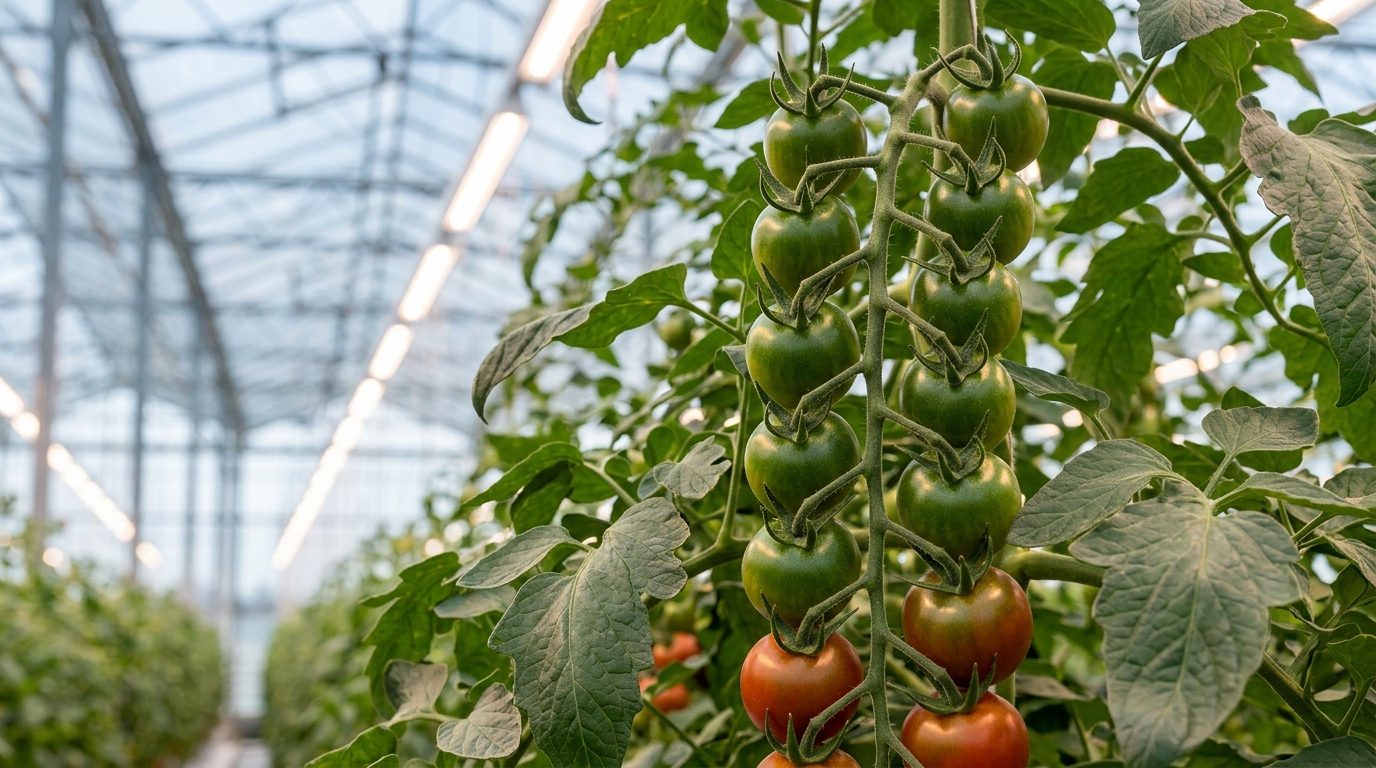
Far-Red Spectrum Optimum in Tomato Lighting: Efficiency Limits
The implementation of LED supplemental lighting in protected cultivation traditionally relies on spectra dominated by the red band (600–700 nm) with minimal presence of far-red radiation (700–800 nm). In standard greenhouse luminaires, the far-red fraction in the FR/(R + FR) ratio often does not exceed 0.10, which is noticeably lower than the natural solar spectrum. Researchers at Wageningen University and Research, in a study published in the scientific journal Frontiers in Plant Science, evaluated the dose-response relationship between crop productivity and the proportion of far-red radiation in the photon flux.
Experimental Parameters and Evaluation Methodology
The study was conducted in two greenhouse compartments over a 20-week period during the winter season (from September to February). The trial evaluated two commercial truss tomato hybrids: Foundation and Trevine. Plants were grown on mineral wool slabs at a planting density of 2.7 plants per square meter using high-wire technology with weekly stem lowering.
The experiment was conducted by varying the supplementary far-red fraction from 0.22 to 0.49 while maintaining a constant photosynthetic photon flux density of 250 μmol/(m²·s) and a 16-hour photoperiod. The baseline spectrum of white LED modules had a red:green:blue ratio of 45:35:20, while the far-red gradient was created by separate modules peaking at a wavelength of 738 nm. Natural solar radiation provided an average of 15% of the daily light integral (DLI).
Yield Response and Saturation Threshold
Productivity analysis showed that the crop response to an increasing far-red fraction is non-linear. Additional far-red radiation increased tomato fruit yield up to a far-red fraction of FR/(R + FR) = 0.40, delivering a maximum yield increase of +16% for both studied cultivars. The increase in fruit harvest occurred primarily due to higher total plant dry mass and the partitioning of assimilates into fruits.
With a further increase in photon flux, the physiological effect saturates. Adding far-red radiation to supplemental lighting linearly increases tomato yield only up to a fraction of 0.40, whereas further increasing the FR fraction has a limited or negative effect on yield and decreases energy efficiency. Fruit quality parameters (soluble sugar content, Brix, titratable acidity) and post-harvest shelf life remained virtually unchanged across all levels of the spectral gradient.
Energy Balance and Return per Kilowatt-Hour
For engineering teams, the operational cost of photon flux remains a critical factor. When calculating the power consumption of LED supplemental lighting, photon efficacy was assumed to be 2.5 μmol/J for white LEDs and 3.6 μmol/J for far-red LEDs.
Despite the high physical efficacy of 730–740 nm semiconductor diodes, radiation use efficiency and electricity use efficiency of supplementary lighting decrease at higher far-red fractions (0.44 and 0.49). An excess of far-red photon flux ceases to be converted into marketable biomass, leading to increased electricity consumption per kilogram of harvested produce.
Implications for Greenhouse Design and Upgrades
When calculating lighting systems for year-round tomato cultivation, the choice of spectral composition determines not only agronomic performance but also the total connected electrical load of the greenhouse facility. In LED supplemental lighting projects, agronomists and designers frequently face the question of how deeply to enrich the spectrum with far-red radiation during retrofits or new construction.
The trial results show that mechanically increasing the far-red fraction above a ratio of 0.40 is economically unfeasible. When planning tomato supplemental lighting projects, a spectral ratio in the range of 0.30–0.40 provides an optimal balance between morphogenesis stimulation and product yield per kilowatt-hour consumed. Additionally, the influence of spectral parameters and rootstocks on overall productivity was discussed in the review on supplemental lighting and tomato productivity: rootstock and lighting regime effects.
Transferability Limitations
Applying these findings to commercial greenhouse conditions requires considering several limitations:
- The trial was conducted on specific European hybrids (Foundation and Trevine); the response of other varieties and regional hybrids to far-red light may exhibit a different saturation threshold.
- The experiment modeled winter conditions at a constant PAR level of 250 μmol/(m²·s). Facilities with different baseline lighting levels or hybrid schemes using HPS lamps will have a different balance between natural and artificial spectra.
- Carbon dioxide concentration in the study was maintained at 530 μmol/mol; under different microclimate and fertigation parameters, assimilate partitioning may proceed differently.
Recommendations for Technical and Agronomic Specialists
Chief agronomists, lighting designers, and chief engineers preparing technical specifications for horticultural luminaires are advised to:
- Evaluate spectral composition not in isolation from luminaire datasheets, but based on the total FR/(R + FR) fraction within the operating photon flux at the canopy level.
- Avoid designing for a far-red fraction above 0.40, as further increases do not yield commercial gains and impair the energy efficiency of the installation.
- When performing techno-economic evaluations of spectral options, calculate output per kilowatt-hour of total consumed power, balancing the capital expenditure for additional modules against projected fruit yield gains.