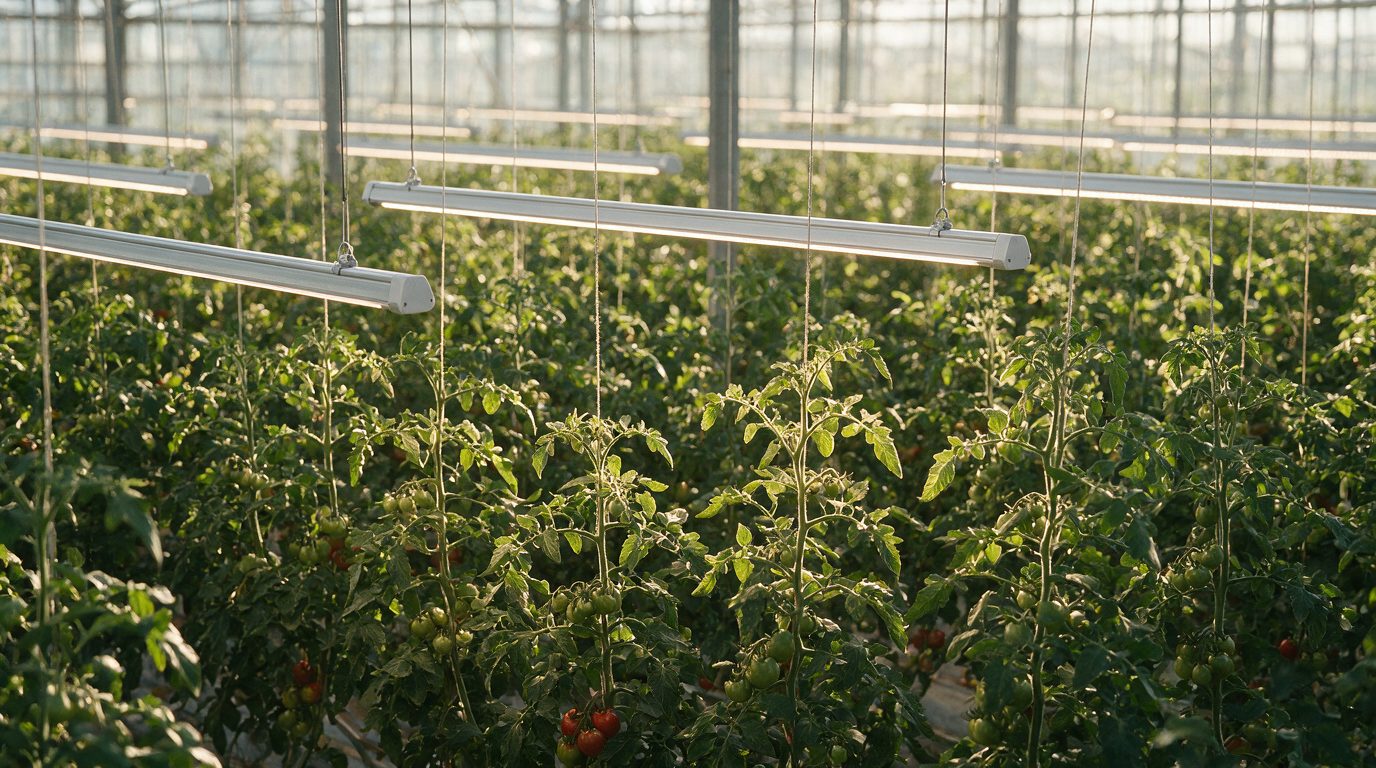
Tomato Supplemental Lighting: Effects of Light Regimes and Rootstocks
Managing the productivity and organoleptic qualities of tomatoes in protected cultivation requires synchronizing the lighting regimen, the physiological status of the root system, and microclimate parameters. Under supplemental lighting, agronomists often face situations where adjusting irradiance levels or spectral composition fails to deliver the expected increase in dry matter or marketable fruit weight without concurrent optimization of the root zone. A research team led by C. Sat examined the impact of agrobiological factors on yield formation and quality parameters in tomato (Sat et al.), while related studies confirm that complex LED light regimens differentially regulate growth processes, fruit set, and quality (Scientific Reports).
Experimental Data on Productivity and Fruit Quality
During the research, scientists analyzed plant growth parameters, yield structure, and the accumulation of total soluble solids. Scion-rootstock interactions and vegetative development dynamics were evaluated.
Researchers recorded a pronounced response in biometric and productive performance. In particular, using the Long green eggplant (LGE) rootstock resulted in the highest number of fruits per tomato plant at 100.00. At the same time, the total yield per plant when grafted onto the LGE rootstock reached 1328.70 g, demonstrating high efficiency in assimilate partitioning toward generative organs while maintaining root system activity.
In parallel, the effect of treatments on organoleptic properties and biochemical composition was evaluated. Analysis revealed that total soluble solids (TSS) in tomato fruit on LGE and Sida (SD) rootstocks reached the highest levels at 9.82% and 9.60%, respectively. Elevated dry matter concentration directly determines fruit flavor characteristics and firmness, which is taken into account when planning greenhouse produce marketing.
Implications for Commercial Greenhouse Operations
For the chief agronomist and protected cultivation specialists, these findings are essential for managing plant carbohydrate balance under supplemental artificial lighting. High photosynthetic rates under LED lighting require corresponding root system capacity for water and nutrient uptake. If the root system cannot cope with transpiration pull and assimilate translocation, even an optimized grow light spectrum will not achieve target sugar accumulation in fruits.
When designing and retrofitting lighting installations, engineers consider how photon flux aligns with crop management practices. Evaluating combined lighting strategies, such as hybrid supplemental lighting vs full LED, demonstrates that microclimate and root zone management must be synchronized with the photoperiod schedule. Fine-tuning irradiation parameters enables balancing vegetative and generative growth, as detailed in the analysis on supplemental lighting control via chlorophyll fluorescence.
Limitations of Applying Research to Commercial Practice
When transferring experimental results to commercial greenhouse production, technological differences must be considered:
- Experimental data were obtained under strictly controlled conditions, where temperature gradients, substrate moisture, and nutrient solution concentration were maintained without the sharp fluctuations typical of industrial-scale facilities.
- Graft combination performance and lighting response depend on the specific hybrid, substrate type, and planting density.
- The root zone's contribution to sugar accumulation must be evaluated alongside photosynthetically active radiation levels and daily light integral (DLI), which vary in commercial greenhouses depending on solar radiation.
Practical Recommendations for Specialists
Before modifying supplemental lighting parameters or crop training schemes, the chief agronomist is advised to evaluate root pressure and assimilate export dynamics toward fruit trusses. If the objective is to increase fruit firmness and soluble solid content, root system capacity and mineral nutrient availability should be assessed alongside lighting regimens.
Greenhouse design engineers calculating supplemental lighting systems should incorporate zoned light intensity control to adjust artificial radiation levels according to actual vegetative canopy mass and fruit load.