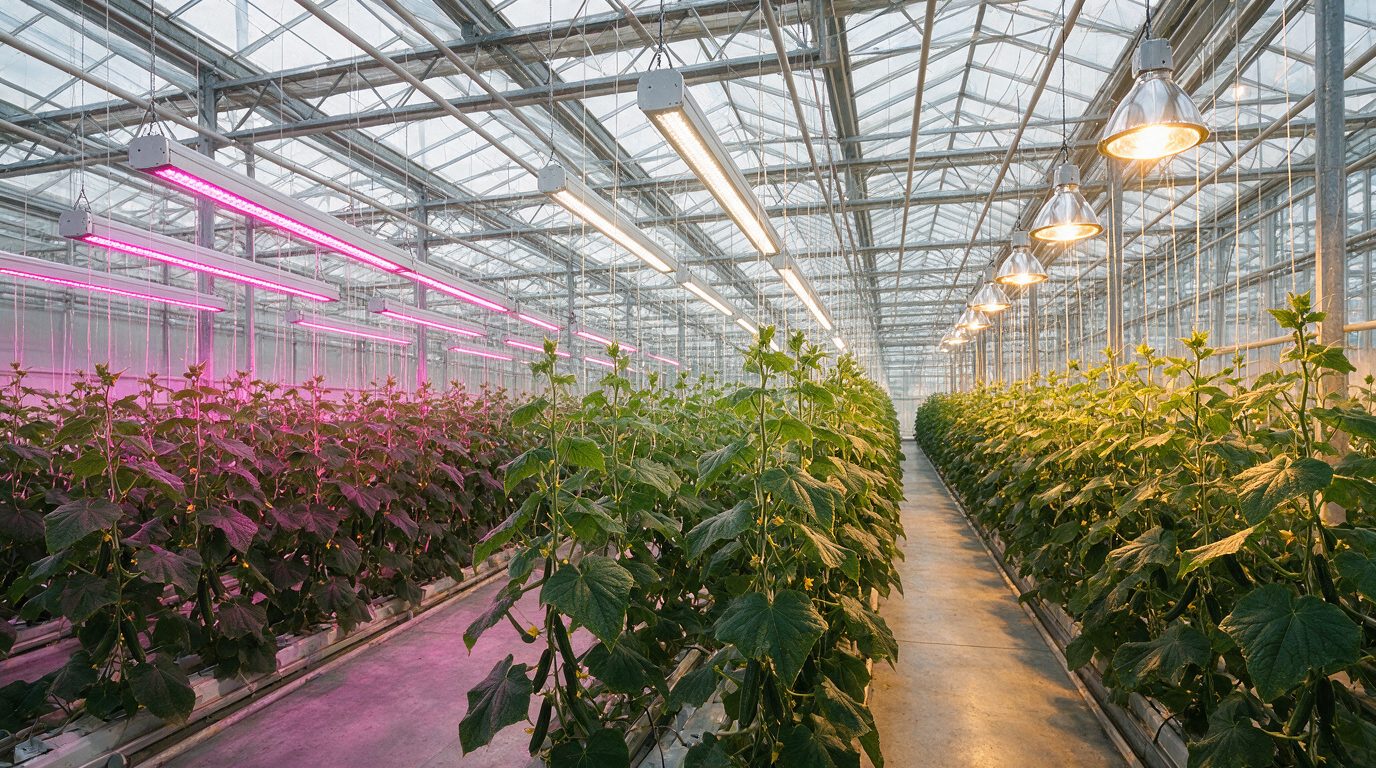
Horticultural LEDs, White LEDs, and HPS for Cucumber: Yield vs Cost Balance
The choice of supplemental lighting in protected cultivation determines gross crop yield and operational costs for commercial greenhouses. Traditional high-pressure sodium (HPS) lamps have long remained the industry benchmark due to high light output in the red-orange spectral region. However, advancements in solid-state lighting present growers with a practical question: is the higher capital expenditure of specialized horticultural LEDs justified compared to more affordable industrial white LEDs and classic HPS fixtures when cultivating light-demanding crops?
In a study published in the journal Horticulturae, a research team conducted comparative trials of four lighting strategies in commercial greenhouse cucumber (Cucumis sativus L.) production. Supplemental lighting intensity across all experimental treatments was maintained at 250 μmol/(m²·s). The trial evaluated crop growth parameters, physiological status, fruit yield, and the overall structure of energy and capital expenditures.
Yield and Plant Morphology
Trial results indicated that the highest gross yield was achieved under high-pressure sodium lighting. When testing cucumber supplemental lighting systems, yield under high-pressure sodium lamps (HPS) reached 42.86 kg/m², under specialized horticultural LEDs (hLED) was 39.03 kg/m², under industrial white LEDs (iLED) was 38.84 kg/m², and the unlit control group produced 30.16 kg/m².
Spectral composition substantially influenced plant architecture. The HPS spectrum, dominated by yellow-orange wavelengths, stimulated internode elongation and increased overall canopy height. In contrast, LED systems containing a blue spectral fraction produced a more compact plant habitus with shorter internodes and well-developed leaf area. Notably, the yield difference between specialized horticultural LEDs and industrial white LEDs was minimal, amounting to less than 0.2 kg/m².
Physiological Parameters and Electricity Consumption
Gas exchange and water regime assessments revealed distinct physiological responses to luminaire type. The intrinsic water use efficiency (iWUE) in plants under iLED averaged 35.65 μmol CO2/mol H2O, compared to 24.55 under HPS and 22.04 in the control group. Reduced non-productive transpiration under LEDs indicates optimized stomatal regulation and stable photosynthetic activity without excessive plant water stress.
The energy balance demonstrated a clear advantage of LED technology over traditional gas-discharge sources. Electricity consumption of industrial white LEDs (iLED) was 378.31 kWh/m², horticultural LEDs (hLED) was 465.39 kWh/m², and HPS lamps consumed 634.53 kWh/m², providing iLED with energy savings of 40.38% compared to HPS and 18.71% compared to hLED. This reduction in power consumption directly lowers the load on distribution grids and on-site generation infrastructure.
Capital Expenditure and Economic Balance
A comparison of upfront fixture acquisition costs revealed a significant spread among LED module types. Initial capital costs for iLED installation were 124.20 CAD/m², whereas HPS costs were 32.26% higher (164.26 CAD/m²), and specialized hLEDs were 102.91% higher (252.00 CAD/m²). The premium cost of specialized horticultural LEDs is largely driven by narrow-band deep-red emitters and specialized secondary optics.
The researchers noted that the rated operating lifespan of both LED module types reaches 50,000 hours, compared to 24,000 hours for HPS lamps. Combined with the lowest electricity consumption, the industrial white LED setup delivered the highest net economic return under the modelled trial conditions.
Implications for Commercial Greenhouse Operations
For commercial facilities, these findings provide an empirical foundation for retrofitting existing lighting installations. Practical experience shows that replacing HPS with LEDs in greenhouses requires precise calculation not only of photometrics, but also of the thermal profile. Unlike HPS lamps that emit significant radiant heat directly onto the plant canopy, LED luminaires dissipate heat into the greenhouse volume primarily via heat-sink convection, reducing the risk of localized foliar overheating during warmer periods.
Under constrained electrical capacity, broad-spectrum white LEDs enable growers to decrease power density per square meter while maintaining yields close to those achieved with specialized horticultural luminaires. Commercial grower data also confirms that a systematic comparison of HPS and LEDs in greenhouses, when coupled with adapted microclimate control, helps offset small differences in gross yield through major reductions in kilowatt-hour consumption.
Transferability Limitations
When adapting these experimental findings to commercial practice, several constraints must be considered:
- Economic calculations were based on Canadian electricity rates (0.11 CAD per kWh) and cucumber market prices (2.96 CAD per kg), which differ from cost and revenue structures in other regions.
- The study did not account for additional winter heating costs required to compensate for the reduction in infrared radiant heat from HPS fixtures.
- Trials were conducted at a fixed PPFD of 250 μmol/(m²·s); photosynthetic and yield ratios may shift at different light levels.
Practical Takeaways for Specialists
Based on the experimental data, agronomic and engineering teams should consider the following actions:
- Head Agronomist: Account for LED spectral effects on canopy compactness and adjust crop maintenance strategies for shorter internodes and lower crop transpiration loads.
- Chief Engineer: When calculating lighting retrofits, include actual power demand differences across fixture types and benchmark the 50,000-hour LED lifespan against the 24,000-hour maintenance cycle of HPS lamps.
- Facility Director: Model total cost of ownership against regional power tariffs and module capital costs before approving full-scale lighting replacement budgets.