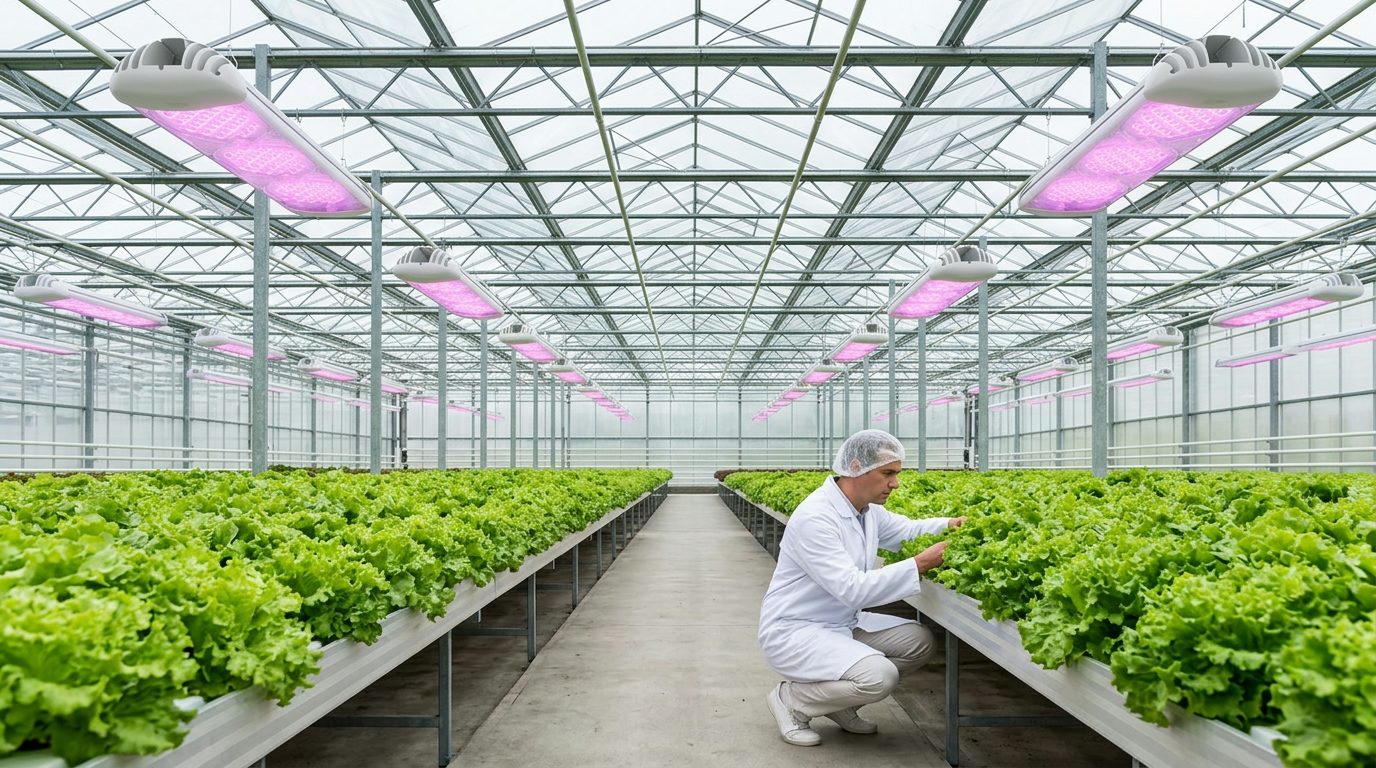
Integrating Vertical Farms with Greenhouses: Revising the Economic Model
The concept of fully enclosed vertical farming, which abandoned natural insolation in favor of indoor multilayer facilities with LED lighting, is undergoing a profound market reassessment. As reported by the specialized trade publication Vertical Farm Daily, initial expectations that indoor farms would universally replace traditional greenhouses have run into severe economic realities: research and development focus in vertical farming is shifting toward integration with traditional greenhouses.
Reasons Behind the Crisis of Standalone Vertical Complexes
Large-scale investments flowing into the vertical farming sector over the past decade failed to deliver sustainable profitability for most full-cycle projects. In recent years, major vertical farming companies have shut down or gone bankrupt, including Future Crops in 2023.
Financial performance proved to be the main barrier to scaling such operations. Vertical farms proved expensive to build and operate, with high electricity costs emerging as a key negative factor. Compelled to expand growing areas to reach breakeven, operators faced mounting debt burdens, rendering the continuous operation of completely artificial lighting environments economically unviable for most crops.
Judith van Heck, project leader of Fieldlab Vertical Farming at Greenport West-Holland, notes that the investment hype around indoor farms created inflated expectations: vertical farming is not a universal solution for all challenges ("the holy grail"), but the development of this field has provided the industry with many valuable practical insights. The accumulated expertise in precision microclimate management and artificial lighting is now finding practical application when paired with classic greenhouse blocks.
The Hybrid Model: Indoor Propagation Chamber and Glazed Greenhouse Block
Transferring vertical farming methods into the perimeter of a commercial greenhouse complex fundamentally alters how artificial lighting and floor space are utilized. In a standalone indoor farm, grow lights must fully substitute for natural sunlight across all vegetative stages, driving up kilowatt-hour consumption per kilogram of finished yield. In a hybrid setup, an enclosed multilayer block is deployed selectively—during seed germination, rooting, and young plant or seedling propagation.
During juvenile development stages, plants occupy minimal surface area, allowing high densities of propagation material across multiple tiers within a compact, isolated module. Comprehensive control over photoperiod, spectral composition, and PPFD levels across the shelving creates uniform transplants with well-developed root systems regardless of seasonal weather fluctuations. Once sufficient vegetative mass is established, plants transition into main glasshouse compartments, where the sun provides the baseline photosynthetic load and overhead luminaires supply supplemental lighting. To evaluate the energy balance of such configurations, operators can reference findings on hybrid supplemental lighting versus full LED in commercial greenhouses.
Implications for Facility Design and Commercial Economics
For protected cultivation facilities where grid connection costs and electricity tariffs directly drive production costs, integrating vertical propagation modules offers clear practical value when designing new production phases or retrofitting existing operations:
- Reduction in required seedling area: Multilayer layouts free up valuable greenhouse footprint for continuous fruiting of main crops.
- Lower connected electrical load per unit of output: Concentrated LED lighting in a compact nursery compartment demands less total electrical capacity than supplemental lighting distributed over expansive horizontal floors.
- Process cycle stabilization: Eliminating temperature and light fluctuations during early plant stages delivers uniform planting material precisely on schedule.
- Mitigated pathogen pressure: An enclosed module shields young seedlings from external pests and diseases until natural plant vigor and immunity are established. Managing spectral distribution and crop acclimatization remains critical, as demonstrated in lettuce cultivation research in a winter greenhouse.
Engineering Challenges and Transition Constraints
Integrating a multilayer module into a greenhouse complex introduces specific engineering challenges absent in standard horizontal bench layouts:
- Thermal balance and air exchange: High-density multilayer configurations with LED luminaires concentrate thermal dissipation within a constrained volume. Designers must dimension forced ventilation, air conditioning, and dehumidification systems to prevent stagnant humid air pockets between shelving tiers.
- Acclimatization stress: Moving plants abruptly from a climate chamber with a fixed spectrum, constant temperature, and zero UV radiation into natural sunlight inside a glazed greenhouse can trigger photic and thermal shock. Implementing progressive lighting and climate hardening protocols mitigates this risk.
- Intra-facility logistics: Transferring plug trays from upper vertical tiers into the main greenhouse requires optimized transit paths and lifting platforms; otherwise, floor-space savings are offset by increased labor overhead.
Key Takeaways for Management and Engineering Teams
When assessing facility expansion or modernization plans, it is counterproductive to view vertical farming and traditional greenhouses as competing alternatives. Enclosed multilayer modules should instead be treated as specialized process units:
- For General Directors: Before approving capital allocations for standalone full-cycle indoor farms, compare total cost of ownership against a multilayer seedling module integrated into an existing greenhouse. Directly substituting natural sunlight with artificial light during fruiting stages rarely pays off under current energy tariffs.
- For Chief Engineers and Designers: Account for independent climate control loops between vertical propagation blocks and production zones, ensuring adequate ventilation capacity to exhaust heat generated by power supplies and LED modules.