LED Retrofit Pitfalls: Managing Complexity and Infrastructure Risks
The development of greenhouse technologies and artificial lighting systems is outpacing the practical readiness of commercial greenhouse operations for fault-free deployment. As noted by Greenhouse Grower editor Brian Sparks, the accelerated rollout of complex lighting systems creates a noticeable gap between laboratory potential and the actual capabilities of active facilities. In an industry discussion, grow light manufacturers and protected cultivation specialists identified three main barriers: operational overload of control systems, technical risks of premature automation, and severe grid infrastructure limits.
Operational Complexity and the Risks of Adaptive Systems
One of the primary causes of grower disappointment with modern LED installations is excessive equipment complexity. As Brian Sparks emphasized, even if financial calculations look favorable, supplemental lighting technology loses its value if it is too complex to integrate, operate, or troubleshoot within a specific facility. High theoretical energy savings and fast projected payback on paper become meaningless if on-site maintenance staff cannot quickly isolate a power fault, replace a failed driver, or configure basic daily photoperiod routines.
Similar challenges arise when attempting to deploy multicomponent dynamic lighting systems without qualified staff and a robust engineering platform. Jeff Mastin, Director of Lighting Science and Products at TotalGrow Lights, warns that while combining artificial intelligence, advanced sensors, and adaptive lighting to automatically adjust intensity, spectrum, or beam directionality opens significant opportunities, in reality the setup is extremely complex and premature automation carries substantial risks for greenhouse operations. PAR sensor errors, feedback channel drift, or central controller crashes lead to disrupted lighting regimes, uncontrolled photoperiod fluctuations, and reduced crop yields.
An overreliance on custom luminaire modifications tailored to a single project is another major source of hidden costs. Greenhouse Grower notes that while custom lighting solutions offer practical value, they also introduce more variables into ongoing operation and troubleshooting. Non-standard spectral channels, proprietary secondary optics, or custom driver chips complicate spare parts inventory management. As a result, a single component failure can leave an entire module idle for weeks awaiting replacement parts from the manufacturer.
Economic Constraints and Power Infrastructure
The financial justification for retrofitting greenhouses with LED modules depends heavily on the economics of specific crops and the actual condition of electrical distribution networks. Kassim Tremblay, Senior Vice President of Sales and Marketing at Sollum Technologies, points out that while growers understand the physiological need of plants for different light spectra and types, adopting new lighting systems in floriculture is often financially unjustifiable due to tight margins and limited access to electrical grids.
Given the modest profit margins of cut flowers and potted plants, greenhouse enterprises operate with limited working capital. Furthermore, aging substations and wiring runs are frequently unprepared for the specific inrush currents of switch-mode power supplies. If existing market demand is fully met by current yields and the electrical infrastructure requires substantial capital expenditure on substations and switchboards, direct replacement or retrofitting of the lighting system will not achieve a reasonable payback period. Technology must serve the specific economic objectives of the facility rather than abstract market possibilities.
Implications for Greenhouse Modernization
When retrofitting existing facilities and designing new greenhouse blocks, engineering teams must objectively evaluate operational barriers. High concentrations of multi-loop automation require continuous service support, regular spectroradiometer calibration, and in-house industrial automation engineers. When performing a detailed analysis of the costs of dynamic supplemental lighting for cucumbers, agronomic teams must separate proven physiological benefits of spectral variation from the procurement and maintenance overhead of complex controllers.
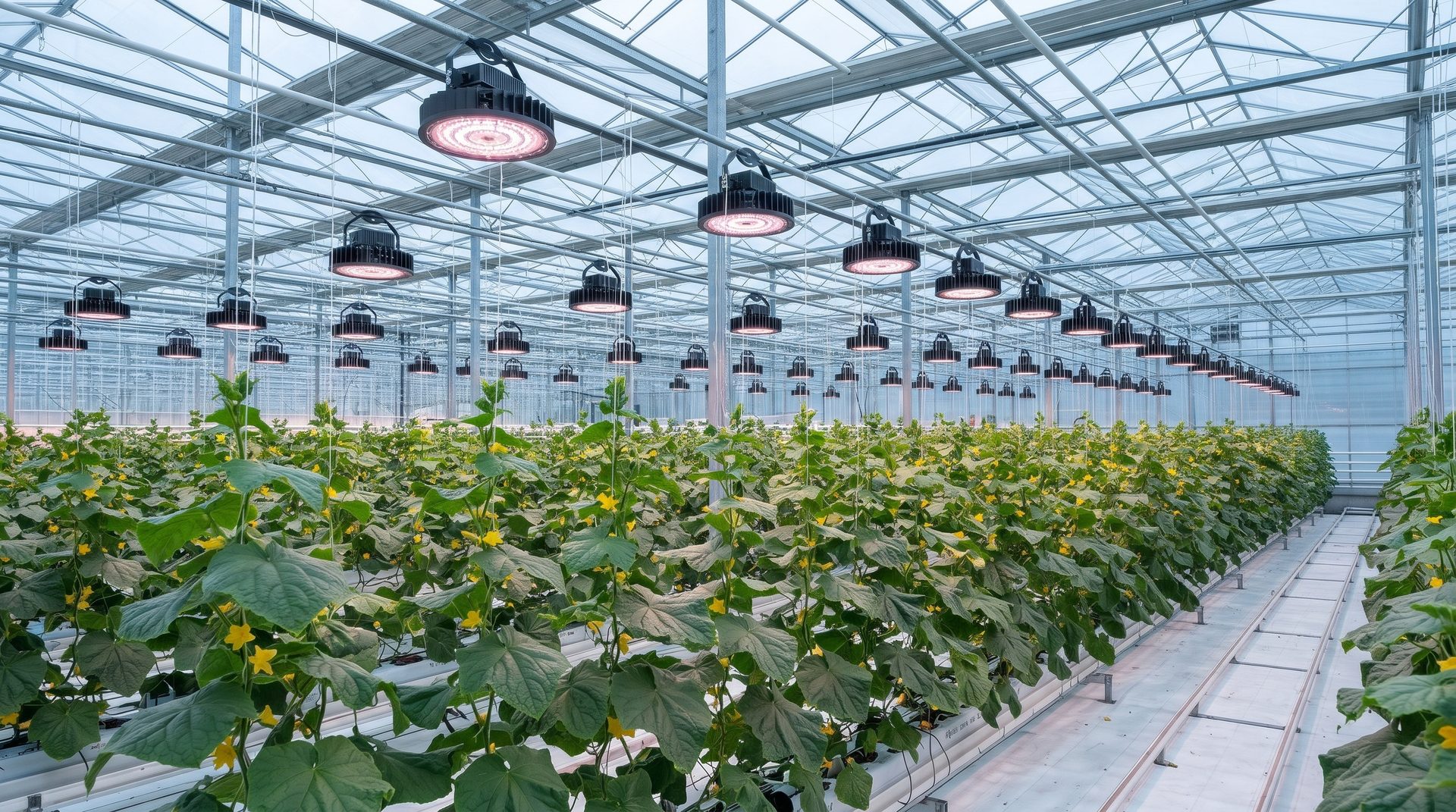
When selecting lighting equipment for vegetable crops, such as developing a comprehensive cucumber supplemental lighting project, priority should be given to maintainable luminaires built with standard, proven components. An optimal combination of a fixed spectrum, durable IP65 or IP67 ingress protection, and standard dimming protocols mitigates production risks far more effectively than implementing a closed, AI-based adaptive lighting platform.
Application Boundaries and Key Takeaways for Agricultural Holdings
While the observations of North American colleagues reflect broader industry trends, they require adjustment for specific operating environments. Key local factors include the availability of regional technical support, supply chain stability for spare parts, energy tariffs, and the operating dynamics of on-site combined heat and power (CHP) generation. Adopting recommendations without an electrical and thermal site audit leads to unjustified expenses.
When drafting technical specifications for a supplemental lighting retrofit, chief engineers and head growers should follow practical guidelines:
- Assess luminaire maintainability: prioritize drivers with standard dimming protocols and verify local warehouse availability for replacement drivers and LED boards.
- Weigh the potential agronomic yield gains of deep customization against the increased costs of maintenance and diagnostics performed by on-duty electricians.
- Conduct an instrumental audit of distribution grids, transformer capacities, and inrush currents before contracting equipment batches.
- Test dynamic spectra and adaptive controls incrementally in isolated propagation compartments to eliminate the risk of disrupting photoperiods in main production zones.