Supplemental Light Spectra and Flower Initiation in Everbearing Strawberries
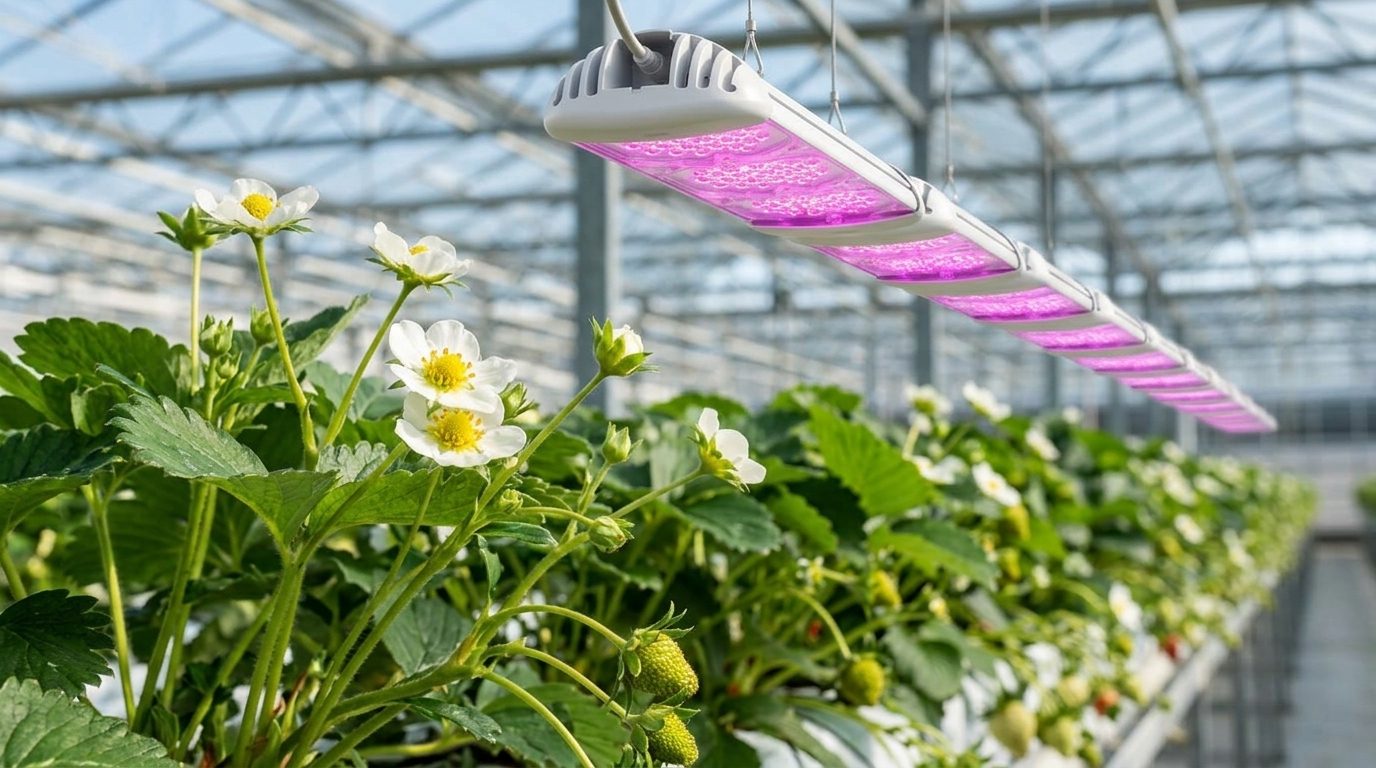
Managing generative organ initiation in everbearing strawberry cultivars remains a complex practical challenge in year-round protected cultivation. For commercial greenhouse operations, maintaining continuous flower budding and uniform harvesting throughout the production cycle without cyclic productivity drops is critical. In the greenhouses of the Dutch university of applied sciences HAS Green Academy in 's-Hertogenbosch, a joint research project initiated with Gavita International has started. According to industry portal HortiDaily, the study focuses on how different LED light spectra affect flower initiation, plant architecture, microclimate, and the development of everbearing strawberries.
Research Objectives and the Specifics of LED Supplemental Lighting
Transitioning to solid-state horticultural luminaires in berry greenhouses requires precise tuning of radiation parameters. The project addresses an important challenge: achieving continuous flower initiation and consistent strawberry yields under LED supplemental lighting. Unlike traditional high-pressure sodium (HPS) lamps, LED modules allow flexible variation of spectral composition and photon flux density; however, crop response to fine-tuned spectral adjustments remains incompletely understood.
According to Gavita International agronomist Charlotte Pijnenburg, LED lighting technology is evolving rapidly, but crop responses to different spectra require further study to optimize growing strategies. Understanding the interaction between spectral composition, vegetative development, and productivity is essential for creating sound agronomic protocols and making effective use of LED equipment in commercial berry production.
Timeline and Current Project Status
Third-year Bachelor of Applied Sciences students are conducting the research under the supervision of academy lecturers and company specialists. The project is in its initial stage: data collection and crop development monitoring continue, with the first results expected in early 2027. At this stage, researchers have outlined the general focus, while specific spectral ratios and quantitative irradiance thresholds will be published upon completion of the experimental cycle.
Relevance for Greenhouse Engineering and Agronomic Practice
For greenhouse enterprises and vertical farms, formulating a spectral strategy for everbearing strawberries has direct practical significance. In year-round production under low natural solar radiation, artificial supplemental lighting parameters determine the balance between vegetative growth and continuous flowering. Errors in spectral selection or irradiance levels can shift crop development toward excessive vegetative growth or trigger fruiting periodicity.
When designing strawberry lighting projects, specialists should consider several fundamental lighting factors:
- Adaptability of lighting equipment. Because a universal spectral recipe for continuous flower initiation in everbearing cultivars is still under active research, new facility designs should evaluate fixtures with zoning or dimming capabilities that permit adjusting lighting regimes without replacing luminaires.
- Cultivar-specific responses. Day-neutral everbearing cultivars vary in sensitivity to photoperiod and spectral photon distribution. Operational experience indicates that transferring lighting regimes between cultivar lines without prior trials in small-scale chambers or isolated compartments risks reducing yields. Practical aspects of berry lighting implementation are detailed in strawberry supplemental lighting projects.
- Interplay between lighting regimes and microclimate. LED fixtures emit less radiant heat into the plant canopy compared to HPS lamps. Adjusting spectral composition and photon flux density directly influences transpiration and leaf temperature, requiring synchronized operation of heating, ventilation, and irrigation systems. The impact of lighting regimes on biometric plant parameters is also discussed in the article on spectral composition and dynamic LED lighting for strawberries.
Limitations of Data Transfer
Because official quantitative results from the Dutch study will not be available until early 2027, chief agronomists and engineers should avoid premature conclusions regarding commercial spectra marketed as definitive solutions for everbearing strawberries. Until the methodology, spectral distribution parameters, PAR levels, and temperature regimes are published, the HAS Green Academy trial serves as a research indicator rather than an off-the-shelf production protocol.
Any lighting regime adjustments in active commercial operations must be grounded in controlled production trials that account for the specific cultivar, substrate type, and greenhouse engineering constraints.