LED Spectra and Dynamic Lighting for Indoor Strawberry Growth
Experimental Setup and Spectral Profiles
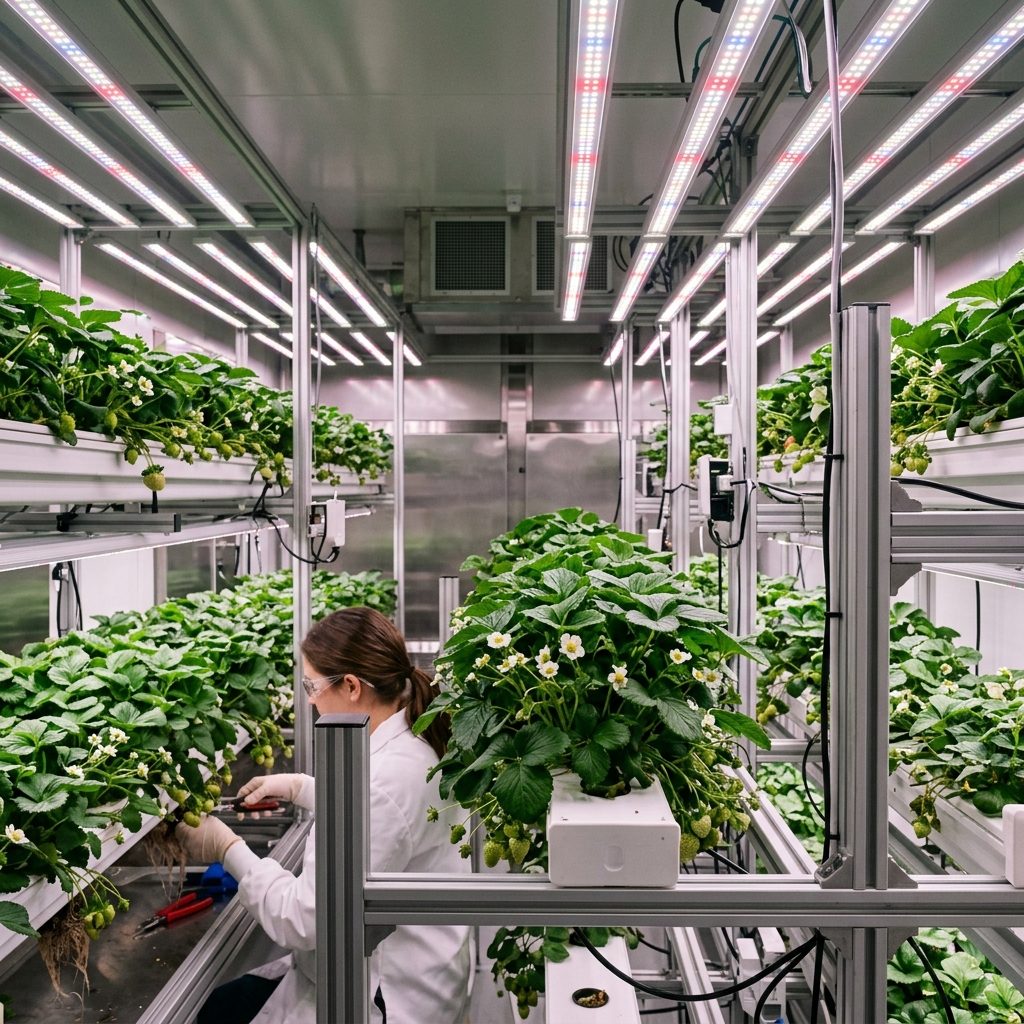
The research team from the Federal Institute of Education, Science and Technology of Goiás (IF Goiano, Brazil) published the results of a 90-day experiment evaluating the effects of LED spectral composition and intensity dynamics on the morphophysiological parameters of strawberry (Albion cultivar). Testing was conducted in enclosed climate chambers on an aeroponic system following two weeks of preliminary seedling acclimation in a greenhouse.
The study compared four spectral treatments of grow lights:
- Cool white light with emission peaks at 450 nm and 557 nm;
- Combined RBW spectrum with three distinct emission peaks: 446 nm (blue), 560 nm (green), and 660 nm (red);
- Monochromatic blue spectrum with a dominant peak at 444 nm;
- Monochromatic red spectrum with a peak at 660 nm.
All treatments were evaluated under a fixed 12-hour photoperiod and a total daily light integral (DLI) of 15.12 mol/(m²·day). Two photon delivery models were compared: constant intensity throughout the entire photoperiod and a sinusoidal regime with smooth ramp-up and ramp-down of photosynthetic photon flux density.
Physiological Response and Energy Efficiency
Instrumental measurements of gas exchange, photosynthetic pigment indices, and chlorophyll a fluorescence showed that the combined RBW spectrum delivered the highest physiological performance. Plants under this light treatment demonstrated increased leaf storage tissue volume, higher photosynthetic rate, enhanced carboxylation efficiency, and improved water-use efficiency. Under high-intensity constant lighting in the RBW and monochromatic red treatments, plants activated non-photochemical quenching mechanisms to dissipate excess radiation energy.
In terms of electricity consumption, the treatments ranked as follows:
- Red spectrum (660 nm) consumed 55.07% less electricity than the control white light;
- Combined RBW spectrum showed a 40.45% reduction in power consumption relative to white light;
- Monochromatic blue spectrum (444 nm) required 10.56% more electricity than the white control source.
Regardless of spectral composition, the sinusoidal radiation regime stimulated plant protective signaling systems and delivered superior morphophysiological leaf indices compared to step-wise constant-power switching. The physiological foundations of such responses are detailed in the article on photoperiod and PPFD optimization under fixed DLI.
Translating Chamber Data to Commercial Greenhouses
Applying these findings in commercial greenhouses requires accounting for the fundamental differences between vertical farming and greenhouse crop production. In an enclosed growth chamber, artificial light provides the entire volume of photosynthetic active radiation. In mid- and northern-latitude greenhouses, natural diffuse light is present even during winter months, partially meeting plant requirements in the green and blue spectral regions.
For winter strawberry production in commercial greenhouse complexes, balancing luminaire capital expenditure with operating cost per kilowatt-hour is critical. The experimental data shows that using pure white light leads to excessive power consumption: the RBW combination saves 40.45% of electricity while simultaneously improving carbon dioxide assimilation. Practical cost calculation aspects are covered in detail in the article on LED spectrum selection for winter strawberries.
Plant responses to sinusoidal lighting confirm the agronomic value of step-wise or smooth supplemental lighting dimming at dawn and dusk. Instead of abrupt load switching on substation transformers, adaptive power control reduces crop light stress and optimizes stomatal conductance during morning hours.
Study Limitations
Direct translation of these results to commercial acreage involves several limitations:
- Cultivation was conducted aeroponically in enclosed chambers without solar radiation, eliminating temperature fluctuations and microclimate non-uniformity typical of greenhouse compartments;
- The study lasted exactly 90 days and was limited to a single day-neutral cultivar, Albion;
- The authors measured leaf physiological parameters and luminaire energy consumption, but the study lacks data on final marketable berry yield per square meter and harvest dynamics.
Takeaways for Agronomists
For supplemental lighting of strawberries in greenhouses, broad-band red-blue luminaires with added white or green components (RBW) remain the optimal choice. This approach reduces installed electrical power by 40.45% compared to full-spectrum white luminaires without risking photosynthetic apparatus degradation.
When designing lighting control panels, zonal dimming via 0–10V or DALI protocols should be specified. Simulating gradual intensity transitions across a 12-hour photoperiod improves stomatal conductance and prevents photoinhibitory stress activation in strawberries when reaching a daily light integral of 15.12 mol/(m²·day).
Sources