Dynamic Spectrum in Commercial Greenhouses: ROI Barriers and Automation Complexity
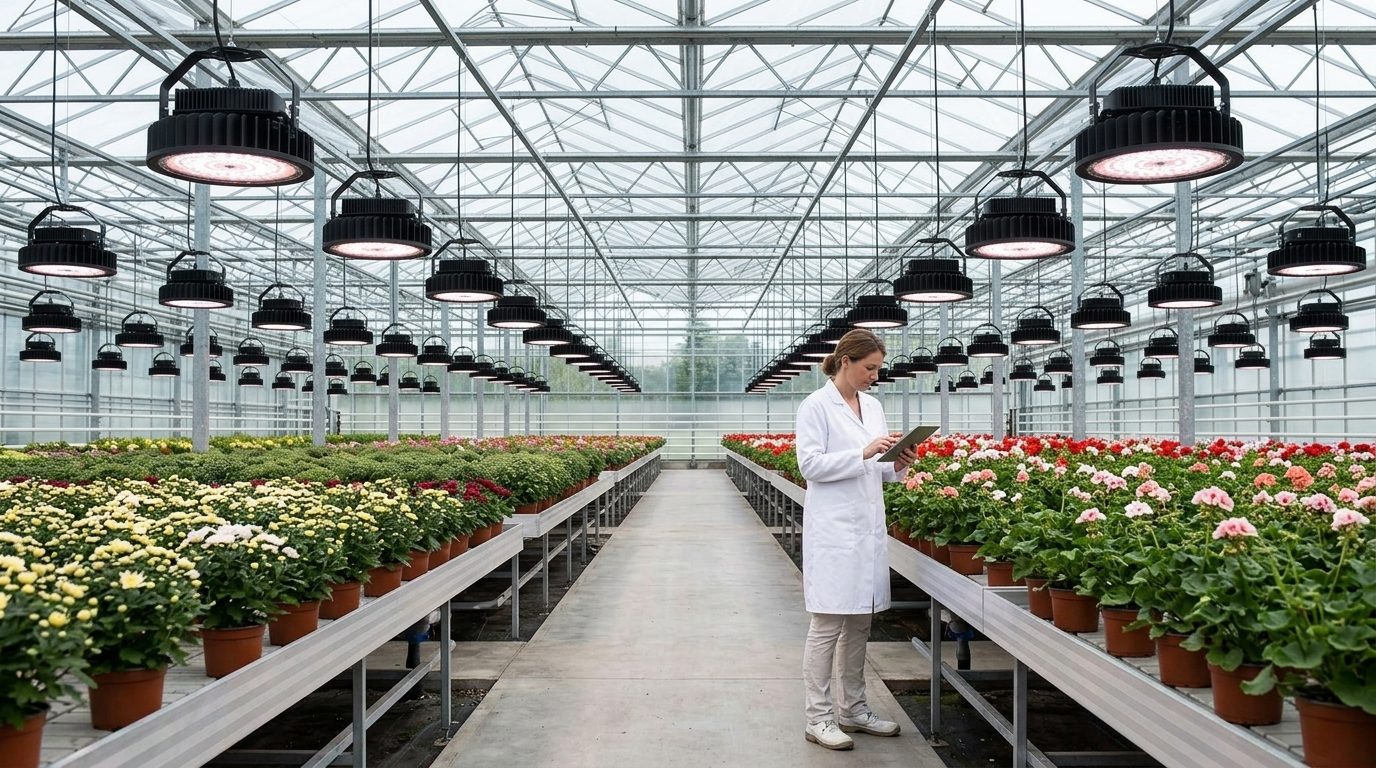
Advances in solid-state lighting have enabled adjustable multichannel systems capable of altering spectral composition throughout plant development. Industry representatives report a transition from high-pressure sodium fixtures and static LED modules toward dynamic supplemental lighting. Kassim Tremblay, Senior Vice President of Sales and Marketing at Sollum Technologies, shared an assessment of current adoption levels, agribusiness payback expectations, and climate control automation trends in an interview with Greenhouse Grower.
Industry Adoption Estimates and Financial Barriers
According to Kassim Tremblay, less than 10% of US floriculture growers currently use dynamic lighting. The slow adoption rate in this segment is driven not by a lack of agronomic knowledge, but by enterprise economics. As the Sollum Technologies executive states, the primary barrier to adopting dynamic lighting in floriculture is financial constraints and the need for capital expenditure amid tight profit margins. Unlike vegetable operations, where demand for year-round local produce stimulates investment, flower growers face limitations regarding electricity access and strict margin thresholds.
Investment discipline sets demanding requirements for protected cultivation equipment suppliers. According to Tremblay, lighting system suppliers for the greenhouse industry are only considered if the payback period is under 5 years, with vegetable and strawberry growers pushing for 18 months. In the indoor vertical farming segment, dynamic spectral control exhibits different results: early-stage trials of dynamic spectrum on an indoor herb farm showed an 18% to 40% increase in productivity compared to white LEDs. However, transferring these performance metrics to large-scale commercial greenhouses requires accounting for external variables.
Increasing Automation and Control Architecture Complexity
Adopting dynamic spectral recipes alters the engineering infrastructure of a greenhouse complex. Tremblay points out that modern lighting control systems are growing more sophisticated through the integration of sensors, AI, and partial decision-making automation. The increasing number of sensors and algorithms is designed to close the control loop and accelerate crop diagnostics; in practice, however, this requires transitioning to more intricate digital communication protocols between drivers and the master greenhouse computer.
When engineering and operating greenhouse facilities, chief engineers must account for the interaction between LED fixtures and automated data acquisition systems. Detailed aspects of sensor instrumentation integration are covered in the article on multichannel grow lights and spectral sensors. Expanding the number of independent spectral channels demands not only robust controllers, but also resilient in-greenhouse communication buses protected from electrical noise and high humidity.
Implications for Russian Greenhouse Operations
For Russian agricultural holdings and greenhouse operations, weighing the capital expenditure of multichannel luminaires against actual economic returns is paramount. Under commercial electricity tariffs, the cost per kilowatt-hour and its conversion into marketable crop yield serve as key investment efficiency criteria. An 18-month payback target, while relevant for berry growers abroad, requires rigorous operational expense analysis in practice. Economic aspects of winter berry lighting are analyzed in the article on the economics of winter strawberry supplemental lighting.
While static LED supplemental lighting delivers a fixed photosynthetic photon flux (PPF) and predictable energy consumption, dynamic systems introduce additional costs for software licenses, sensor fleet calibration, and multicomponent power supply maintenance. When an enterprise retrofits legacy HPS installations or transitions from standard fixed-spectrum LEDs to dynamic fixtures, chief agronomists and financial officers must balance the projected yield gains against the increased automation expenditure per hectare.
Transfer Limitations and Applied Recommendations
When evaluating claims made by equipment developers, facility managers must consider the context and limitations of the presented data:
- The 18-month payback estimate for vegetables and strawberries was stated by a dynamic lighting manufacturer representative and reflects target customer expectations rather than a guaranteed financial outcome across all regions or cultivars.
- The 18% to 40% biomass increase was obtained on an indoor herb farm in comparison with white LEDs, which is not equivalent to supplemental lighting performance in a glasshouse exposed to natural solar radiation.
- The less than 10% adoption rate in US floriculture confirms that dynamic spectrum remains a niche solution even in mature markets due to high capital expenditure requirements relative to crop margins.
Before approving capital expenditures for dynamic lighting equipment, technical and agronomic teams should take the following steps:
- Reconcile project payback targets with the actual farm tariff structure by modeling separate scenarios for energy-efficient static spectrum and a controller-driven dynamic system.
- Assess the reliability of drivers and data transmission channels under continuous operation in a humid greenhouse environment, factoring in a service life of tens of thousands of hours.
- Schedule pilot trials across a restricted footprint (no more than 5–10% of the total lit area) to validate the specific crop response prior to full-scale hectare-level deployment.