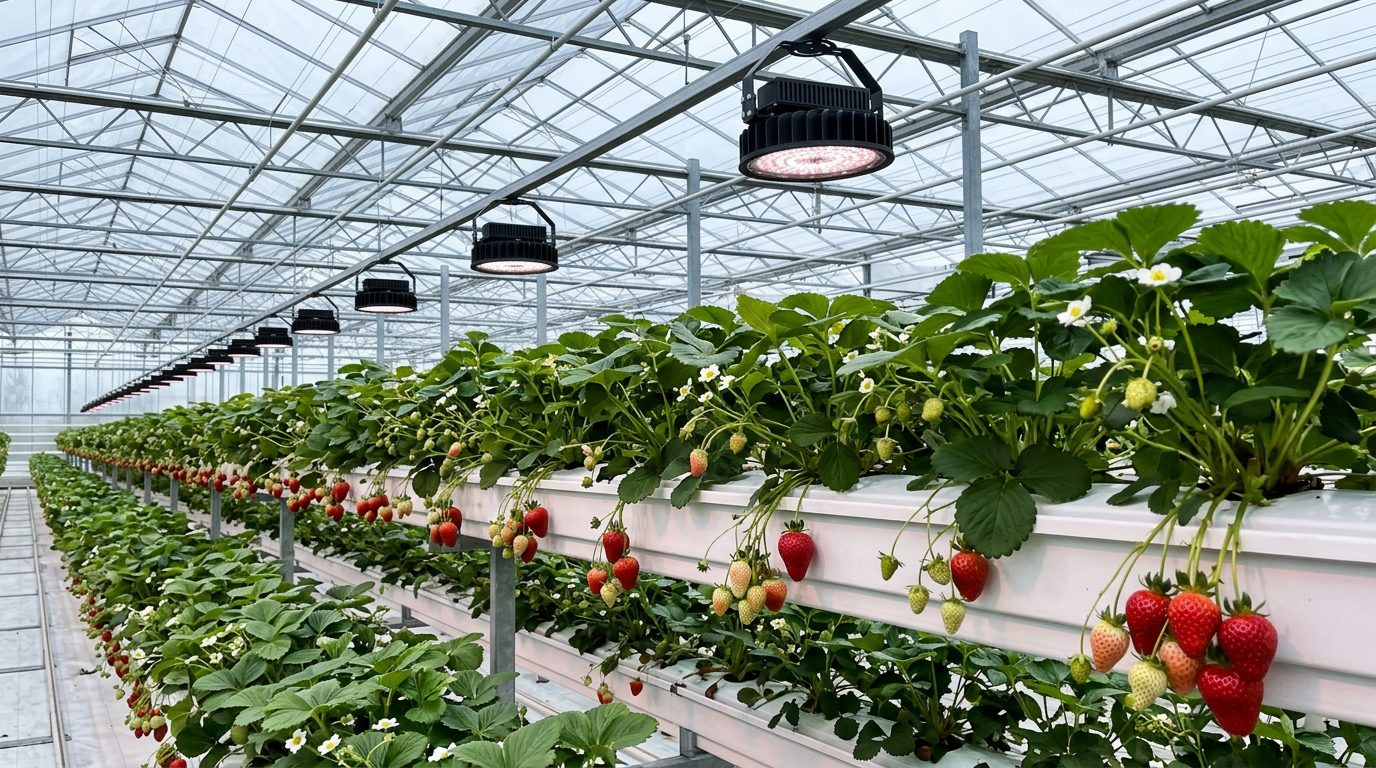
Optimizing Blue Spectrum in Strawberry Lighting: Protected Cultivation Trial Results
Selecting the spectral composition of grow lights for berry crops remains a practical challenge in controlled environment agriculture. Garden strawberries are sensitive to the ratio of spectral wavebands, and the physiological response of the plant depends on the dynamics of photon delivery throughout the photoperiod. A research team led by Carlos Henrique Pereira Bento et al. published the results of an experiment evaluating the effects of monochromatic and combined spectra on strawberry crops in the journal Photochemistry and Photobiology.
Experimental Methodology and Conditions
The study was conducted on the strawberry cultivar Fragaria × ananassa ‘Albion’ in an indoor vertical farming system under controlled temperature and humidity using a vertical aeroponic setup. During the trials, the researchers compared four spectral treatments: monochromatic blue, monochromatic red, a combined red-blue-white (RBW) spectrum, and a white light control. The experiment included two distinct lighting regimes: a constant photoperiod intensity and a sinusoidal regime simulating the daily course of solar insolation.
The researchers evaluated biometric parameters, photosynthetic activity, secondary metabolite synthesis, antioxidant defense enzyme activity, and final plant productivity over eight weeks of fruiting.
Effect of Spectral Composition on Yield
The experimental results demonstrated that strawberry productivity depends on the combination of spectral composition and daily irradiation regime. Under the constant lighting regime, the blue light treatment exhibited the highest values for accumulated fruit number (19.5 ± 1.43), total yield (1.606 ± 0.015 kg), and yield per plant (59.5 ± 0.58 g). Blue light stimulated chlorophyll a accumulation at the flowering stage and promoted the development of shoot vegetative mass.
When the lighting dynamics changed, the plant response shifted. Under the sinusoidal lighting regime, the combined RBW spectrum produced the most promising results, reaching 13.3 ± 1.7 fruits, a total yield of 1.086 ± 0.013 kg, and 40.2 ± 0.5 g per plant. In this treatment, the researchers also observed optimization of photosynthetic balance, increased water-use efficiency, and active synthesis of bioactive compounds: rutin, kaempferol, quercetin, and catechin.
The white light control showed intermediate results: 10.3 ± 0.65 fruits and 0.915 ± 0.011 kg under the constant regime versus 8.4 ± 0.59 fruits and 0.732 ± 0.005 kg under the sinusoidal regime. Monochromatic red light provided consistent stimulation of crown growth and stem diameter, but lagged behind the blue and combined lighting treatments in total productivity and net photosynthetic efficiency.
Practical Implications for Protected Cultivation
The data show that the proportion of the blue waveband in grow light spectra acts as a regulatory factor in strawberry cultivation. An increased share of blue light stimulates stomatal conductance, transpiration, and pigment accumulation. However, transferring these findings into commercial greenhouse facility practice requires accounting for operational factors.
In commercial greenhouse conditions where natural solar radiation is present, the crop already receives a baseline share of natural blue light. Therefore, deploying a pure monochromatic spectrum in a greenhouse complex is impractical. Of practical interest is the combined RBW spectrum, which demonstrated consistent carboxylation efficiency and productivity under a variable light background. For light environment adaptation in berry projects, multichannel grow lights: spectral sensors and automation in greenhouses allow separate control of emission channels.
Data Transfer Limitations
The head agronomist must take into account technological differences between the experimental environment and commercial production:
- The trial was conducted under complete light isolation on an aeroponic setup, where roots and shoots develop in isolated modules, differing from substrate slabs in greenhouses;
- The evaluation was conducted exclusively on the cultivar ‘Albion’, which is a day-neutral hybrid; short-day varieties may respond differently to spectral shifts;
- The study did not evaluate specific electrical energy consumption per kilogram of finished yield for monochromatic blue LEDs compared to full-spectrum solutions.
Before adjusting fixture spectral composition at a facility, agronomists perform express testing of current photon irradiance. The measurement methodology is detailed in LED spectrum and degradation monitoring: rapid field analysis in the greenhouse, enabling verification of actual spectral composition in the crop canopy.
Conclusions for Agronomic Practice
The study results confirm that the blue spectrum activates physiological mechanisms for flower bud initiation and fruit development in strawberries. When designing LED supplemental lighting systems for berry compartments, agronomists should consider:
- Evaluating the blue light fraction within full-spectrum modules (RBW), aiming for balanced leaf canopy development and water balance maintenance;
- Testing the specific cultivated hybrid's response to spectral composition on pilot benches prior to scaling across the entire facility;
- Factoring in the light control strategy: dynamic dimming to buffer peak loads requires combined spectra containing white and red wavebands.