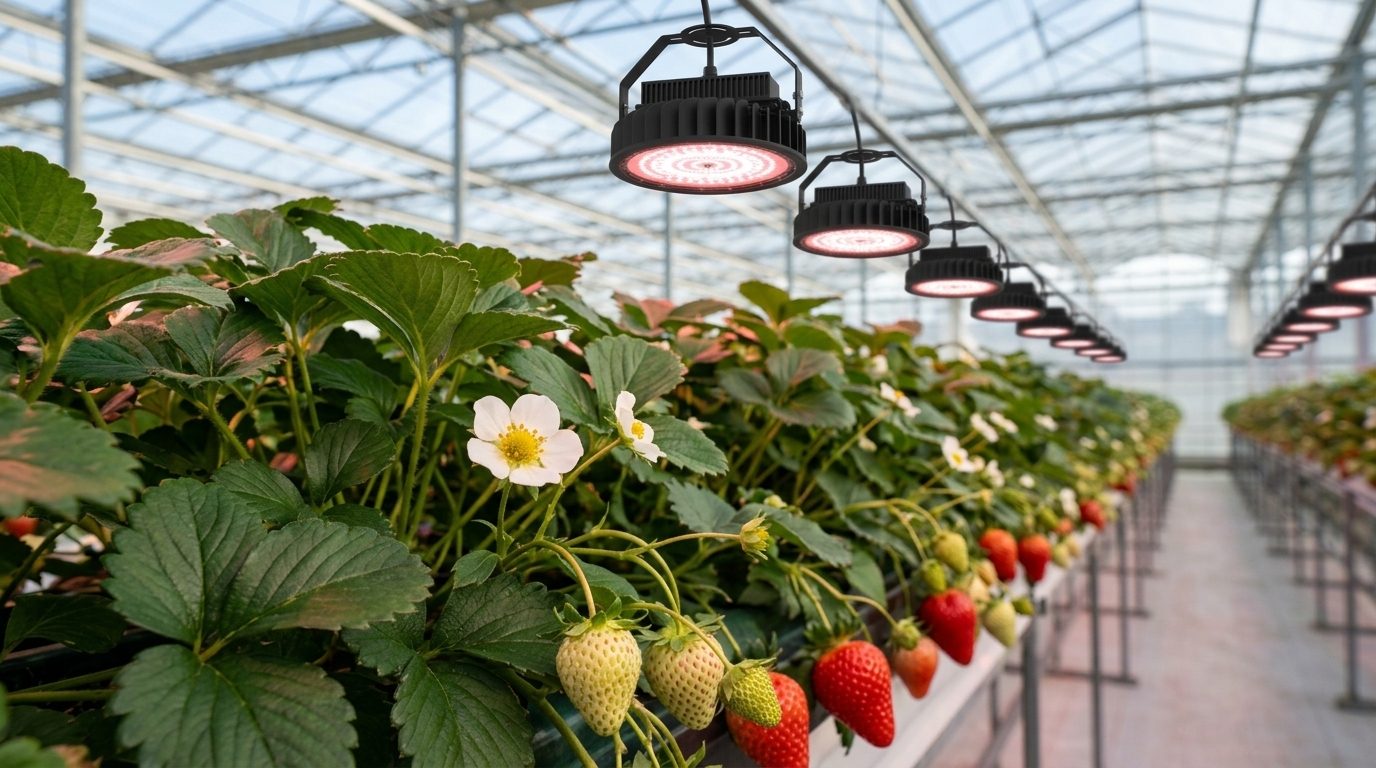
Red-White LED Spectrum for Strawberry Lower Tier in Multi-Tier Greenhouses
Multi-tier hydroponic cultivation of strawberries increases planting density and yield per unit of greenhouse area. However, natural shading of lower tiers by structures and upper plant rows creates a light deficit that hinders canopy development, flower bud differentiation, and final fruit yield. A research team led by Sang Kim (Kim et al.) in a publication in Horticulturae journal presented evaluation results of various supplemental LED lighting spectra to compensate for radiation uniformity deficits in multi-tier 'Seolhyang' strawberry cultivation.
Experiment and Spectral Impact on DLI Deficit Compensation
The experiment compared an unshaded upper control tier (UT-C), a shaded lower control tier (LT-C), and four supplemental LED lighting spectral treatments on the lower tier: blue (LT-B), red (LT-R), a combination of red and white (LT-RW), and a combination of red, white, and far-red (LT-RWF). Measurements showed that the lower tier received 6–8 mol·m⁻²·d⁻¹ less daily light integral (DLI) than the upper tier, whereas supplemental lighting increased DLI by approximately 6.5 mol·m⁻²·d⁻¹.
According to the findings, supplemental LED lighting with a combination of red and white spectra most effectively compensated for lower-tier light deficiency in a multi-tier hydroponic strawberry system. Plants under the red-white spectrum exhibited comprehensive development closest to the unshaded upper tier. Monochromatic treatments provided only partial effects: the blue spectrum stimulated ellagic acid and total sugar accumulation on a dry weight basis, but failed to ensure balanced fresh fruit sizing. The broad-band white component with a pronounced red peak simultaneously stimulated vegetative growth and reproductive productivity.
Productivity and Fruit Marketable Quality
The difference in light conditions affected yield and estimated economic metrics across tiers. In the unlit lower control tier, yield per plant was 102.4 g. Adding an optimized red-white spectrum mitigated the photosynthetic gap: red-white spectrum treatment increased total yield from 102.4 g/plant in the lower control to 359.1 g/plant (65.6% of the upper control) and delivered an estimated gross margin of 48.0% of the upper control level, compared with 18.5% in the lower control.
Beyond gross yield, biochemical and mechanical fruit quality parameters are essential for commercial production. The experiment showed that red-white supplemental lighting maintained higher soluble solids content, SSC/TA ratio, fruit weight, and firmness compared with other lower-tier supplemental lighting treatments. Preserving pulp firmness and the balance of sugars and acidity (SSC/TA) determines shelf life and transportability, directly impacting Class 1 marketable fruit turnout.
Implications for Commercial Greenhouse Facility Design
For agronomic and engineering teams at greenhouse facilities, these data provide benchmarks when engineering multi-tier setups and vertical racking systems. The selection of supplemental light spectra should not rely solely on monochromatic channels. The broad-band white component provides canopy penetration and delivers green and yellow wavelengths that improve optical distribution within the canopy, while the red band ensures high photochemical activity.
When integrating lower-tier supplemental lighting, microclimate and temperature management must be considered. Additional modules close to plants affect transpiration and local root-zone temperature. Comparing spectral interactions with practical regime adjustments is useful: the influence of spectral composition on generative processes is discussed in detail in the article on how supplemental light spectrum affects everbearing strawberry truss initiation, while payback parameter analysis is provided in the material on LED spectrum selection and cost per kilogram in winter strawberry cultivation.
Transferability Limits and Recommendations
When adapting this methodology to commercial facilities, design boundaries of the study should be taken into account. The experiment was conducted on the 'Seolhyang' cultivar in a specific tier geometry; transfer to other everbearing or short-day cultivars will require calibration of photoperiod and photon flux density. Furthermore, the source materials do not detail the exact spectral power ratio of white and red LEDs or the exact linear power density per meter of gutter.
Head agronomists and design engineers modernizing multi-tier systems are advised to:
- Assess the actual seasonal natural DLI gradient between upper and lower tiers before determining luminaire power.
- Deploy full-spectrum red-white LED modules for inter-tier lighting instead of narrow monochromatic bars, monitoring the balance of fruit sugars and firmness.
- Incorporate zone temperature monitoring in the lower-tier root zone to prevent substrate overheating caused by luminaire housing proximity.