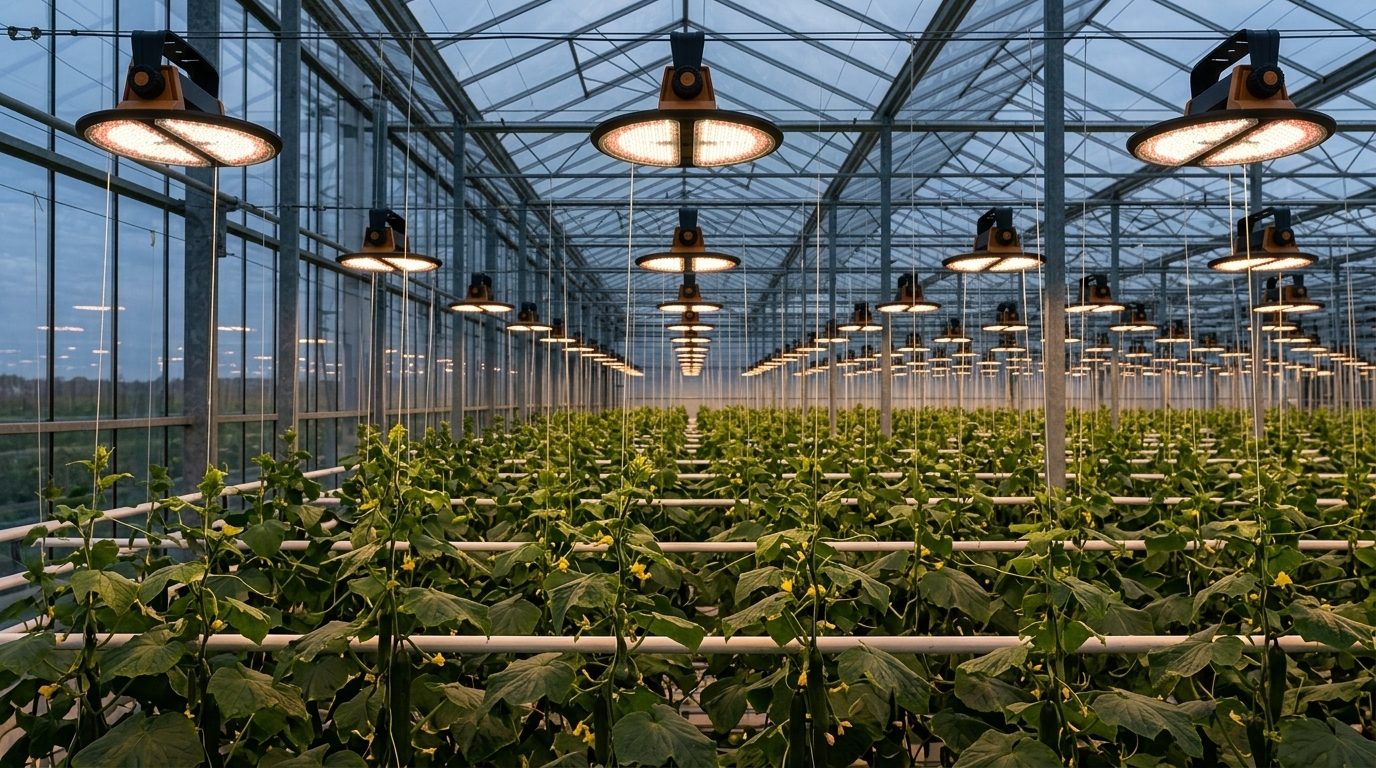
Transitioning 26 Hectares of Cucumbers to LED: Spectrum and Microclimate Challenges
British greenhouse complex Thanet Earth has announced an upgrade of its supplemental lighting system. According to Signify, in the fourth quarter of 2026, a Philips LED lighting system will be installed across about 26 hectares of protected cultivation. This step will allow the enterprise to organize year-round winter cucumber cultivation for the first time, expanding the continuous production practice previously developed by the complex on tomatoes.
Lighting System Specifications and Dynamic Control
Philips GreenPower LED toplighting force fixtures operating under the control of the Philips GrowWise digital system were selected to equip the greenhouses. This engineering solution enables the agronomic team to promptly adjust radiation intensity and spectral composition throughout the day, adapting artificial light to natural solar radiation levels and the current crop development phase.
In the spectrum configuration for cucumber, a far-red spectral channel is provided to stimulate plant stretching, while the dimming function helps maintain crop balance in dark months. Spectral control stimulates growth processes and internode elongation, which is necessary to form proper canopy architecture under a deficit of natural sunlight. Smooth dimming helps maintain vegetative-generative balance during dark winter months without risking canopy overload from excessive photon flux.
Tebarex will handle the engineering integration of the project, including the installation of electrical and water systems, while the project itself builds on the practical experience of Dutch partner Bryte, which already utilizes controllable LED modules for cucumber cultivation.
What a Large-Scale Transition to LED Means for Domestic Greenhouse Complexes
The experience of converting a large greenhouse block to solid-state LED lighting is of direct practical interest to chief agronomists and chief engineers of Russian greenhouse facilities. Winter cucumber cultivation under artificial lighting is traditionally among the most energy-intensive and microclimate-sensitive agrotechnologies. When moving away from high-pressure sodium (HPS) lamps, a greenhouse complex faces a significant transformation in the thermal physics of the cultivation facility.
Traditional sodium lamps direct a substantial portion of consumed electrical power straight to the plants as radiant heat, effectively warming the upper leaf canopy and the shoot apex (growing point). LED fixtures deliver significantly higher luminous efficacy, producing more PAR photons per joule of consumed energy, but provide virtually no directed infrared radiation toward the plant canopy. Under cucumber cultivation, this necessitates recalibrating heating circuit control algorithms: the lack of overhead heat must be compensated for by increasing temperatures in overhead, under-gutter, and inter-row pipe heating loops.
The application of a dynamic spectrum with a controllable far-red channel enables plant morphogenesis control in the absence of radiant heating. The physiological aspects of spectral composition are examined in detail in the review on red and far-red spectrum balance in cucumbers. Simultaneously, the controllable dimming system reduces supplemental lighting intensity as natural solar radiation increases, lowering loads on on-site cogeneration and the external electrical grid.
Transfer Limitations and Operating Considerations
When considering the Thanet Earth project as a technological benchmark for upgrading domestic greenhouse facilities, several climatic and operational factors must be taken into account:
- Climatic conditions: the mild maritime climate of south-east UK is characterized by moderate winter temperatures, reducing specific transmission heat losses through building envelopes compared to light zones II–IV of Russia;
- Heating balance: when transitioning fully to LEDs, a Russian enterprise must pre-calculate the boiler plant reserve thermal capacity for warming the upper canopy to eliminate the risk of chilling the growing point during freezing periods;
- Technological scenarios: for a portion of existing greenhouse blocks, an economically viable phased approach remains modernization while maintaining hybrid lighting, as detailed in the comparison of hybrid supplemental lighting and full LED, where part of radiant heat is retained through baseline HPS luminaires.
Practical Steps for Agronomic and Engineering Teams
Chief agronomists and greenhouse engineers planning retrofits or designing new supplemental lighting systems for cucumber crops are advised to:
- Perform a coupled thermal and lighting calculation: determine leaf and growing point temperatures under design minimum winter ambient temperatures without HPS infrared warming;
- Incorporate zoned and spectral control: provide separate dimming and channel-by-channel far-red control for flexible regulation of growth rates and internode elongation;
- Ensure deep integration with greenhouse automation: fixture dimming protocols must be directly interfaced with the climate computer to automatically compensate for fluctuations in natural solar radiation.